
It doesn’t start with a final or a headline match.
It starts quietly — early morning, before the traditional sports cycle even begins. Screens are already active, not for a single game, but for a sequence that will run for hours.
For a growing segment of American fans, football is no longer consumed as an event with a defined beginning and end. It operates as a continuous flow — multiple leagues, overlapping kick-off times, parallel matches across England, Italy, Germany and the United States. What once required deliberate choice has become a system of simultaneous engagement, extending across entire weekends.
This shift is not stylistic.
It is structural.
And for the first time, it can be measured — in time spent, in platforms used, and in the scale of audience expansion itself.
A market that has already shifted
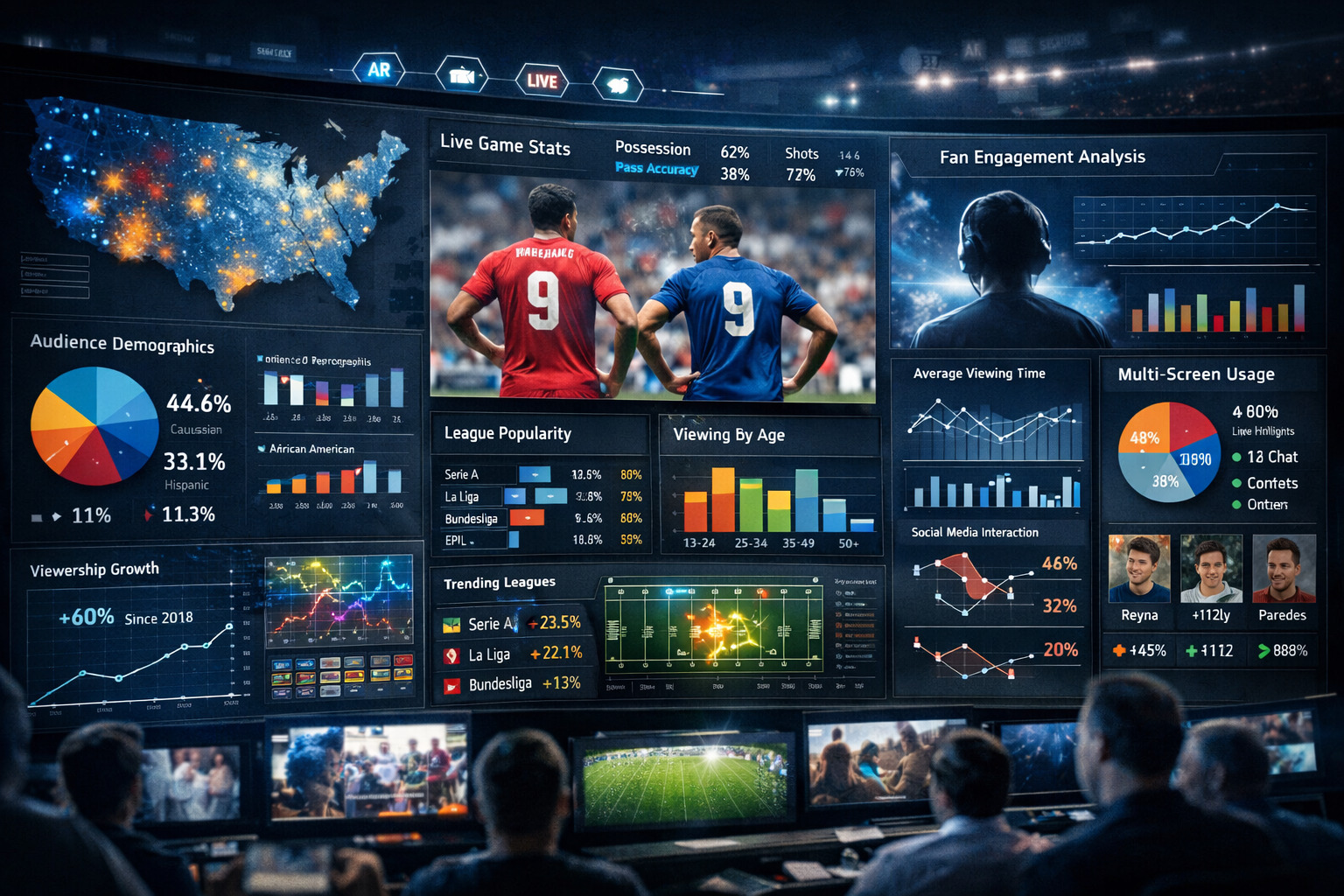
Between 2018 and 2024, the number of Americans watching international football (excluding domestic teams) grew from approximately 31.4 million to over 50.3 million — a 60% increase in six years, a pace rarely seen in mature sports markets.
What makes this growth structurally different is not just its size, but its composition.
Unlike traditional US sports ecosystems, typically anchored around a single domestic league, football offers a fragmented but continuous supply of competitions. Viewers do not replace one league with another.
They layer them.
This produces a fundamentally different model of consumption:
no fixed weekly rhythm
no single narrative axis
no clear endpoint
Consumption becomes distributed — across time, platforms and competitions.
The multi-league effect
The English Premier League remains the primary entry point, reaching approximately 36.2 million viewers, or about 72% of total international football consumption in the US.
But its dominance is no longer exclusive.
Parallel viewing defines the current landscape:
Champions League: 21.8 million
LaLiga: 13.7 million
Liga MX: 9.2 million
Bundesliga: 8.6 million
The shift is not that other leagues are replacing the Premier League.
It is that audiences are no longer choosing between them.
They are consuming across them.
This marks a transition from loyalty-based viewing to portfolio-based consumption.
Growth is uneven — and that asymmetry defines the market
Total growth masks internal redistribution.
Some leagues are accelerating:
Serie A: +23.5%
LaLiga: +22.1%
Bundesliga: +13%
This expansion correlates with improved broadcast strategies, stronger narrative framing, and more accessible presentation for US audiences.
Others are declining:
Champions League: –5%
Liga MX: –8%
Ligue 1: –30.2%
Each decline reflects structural friction.
The Champions League faces format saturation and fragmented distribution. Liga MX, despite cultural proximity, is losing ground to European competition. Ligue 1’s sharp drop reflects limited competitive depth and weaker global positioning.
The assumption that more access automatically leads to more engagement no longer holds.
What emerges instead is a selective audience model, where viewers evaluate the full product — quality of play, storytelling, broadcast experience and relevance within a broader ecosystem.
Player pathways as audience drivers
The Bundesliga illustrates how viewership is shaped by player development.
Its US audience remains smaller than that of the Premier League, but stable and strategically significant. One key factor is the presence of American players:
Gio Reyna
Joe Scally
Kevin Paredes
James Sands
Viewers are no longer following leagues abstractly.
They are following trajectories.
Germany’s structural openness — younger squads, more playing time, fewer regulatory barriers — makes it a natural development hub for US talent.
This creates a reinforcing cycle:
development → visibility → viewership → further engagement
Regional concentration and expansion
Football consumption in the US is no longer coastal.
Three distinct regional dynamics emerge:
Southern United States (41% of total audience)
Driven by demographic diversity, immigration patterns and strong MLS presence.
Pacific region (12.6 million viewers)
A hybrid ecosystem combining Liga MX dominance with diverse international viewing habits.
West South Central (fastest growth)
Particularly Texas, with significant increases:
LaLiga: +120.8%
Serie A: +82.6%
Champions League: +69.5%
This is not just growth.
It is market deepening.
A fully diversified audience — and a structurally stable one
Soccer in the US is no longer tied to a single demographic entry point. It has evolved into a fully distributed, multi-layered audience base.
Current composition reflects that shift:
44.6% Caucasian
33.1% Hispanic
~11% African American
~11% other groups
This distribution signals a transition from identity-driven consumption to cross-demographic normalization.
Historically, Hispanic audiences drove early growth through Liga MX and national team engagement. That influence remains important, but no longer dominant.
Parallel expansion among other demographic groups reflects broader accessibility through streaming, global player visibility and MLS integration.
The result is not just diversity.
It is convergence.
Audiences are no longer segmented by league or identity.
They are participating in a shared ecosystem.
Read more — explore deeper shifts across sport, media and fan behavior
A structurally mature audience
Age distribution confirms market depth:
Ligue 1 attracts the youngest viewers (13–24)
LaLiga and Champions League remain balanced
Premier League skews older (50+)
For many fans, the Premier League serves as the entry point, with engagement expanding into other competitions over time. Fandom develops in layers, not replacements.
Gender dynamics reinforce this shift:
Liga MX: 42% female viewership
LaLiga: 37.4%
Premier League: 30.2%
This is not incremental change.
It is a structural redefinition of the audience.
At the same time, domestic football continues to grow alongside international consumption. MLS has expanded by +57% since 2018, reaching 11.4 million in stadium attendance in 2024.
The relationship is not competitive.
It is cumulative.
By 2026, the US will not function as an emerging market, but as a developed ecosystem with its own consumption logic — multi-league exposure, tactical awareness and selective viewing habits.
The question is no longer who watches football in America.
But how it is consumed.
Not as isolated events, but as a continuous system where time, attention and choice are distributed across a global structure.