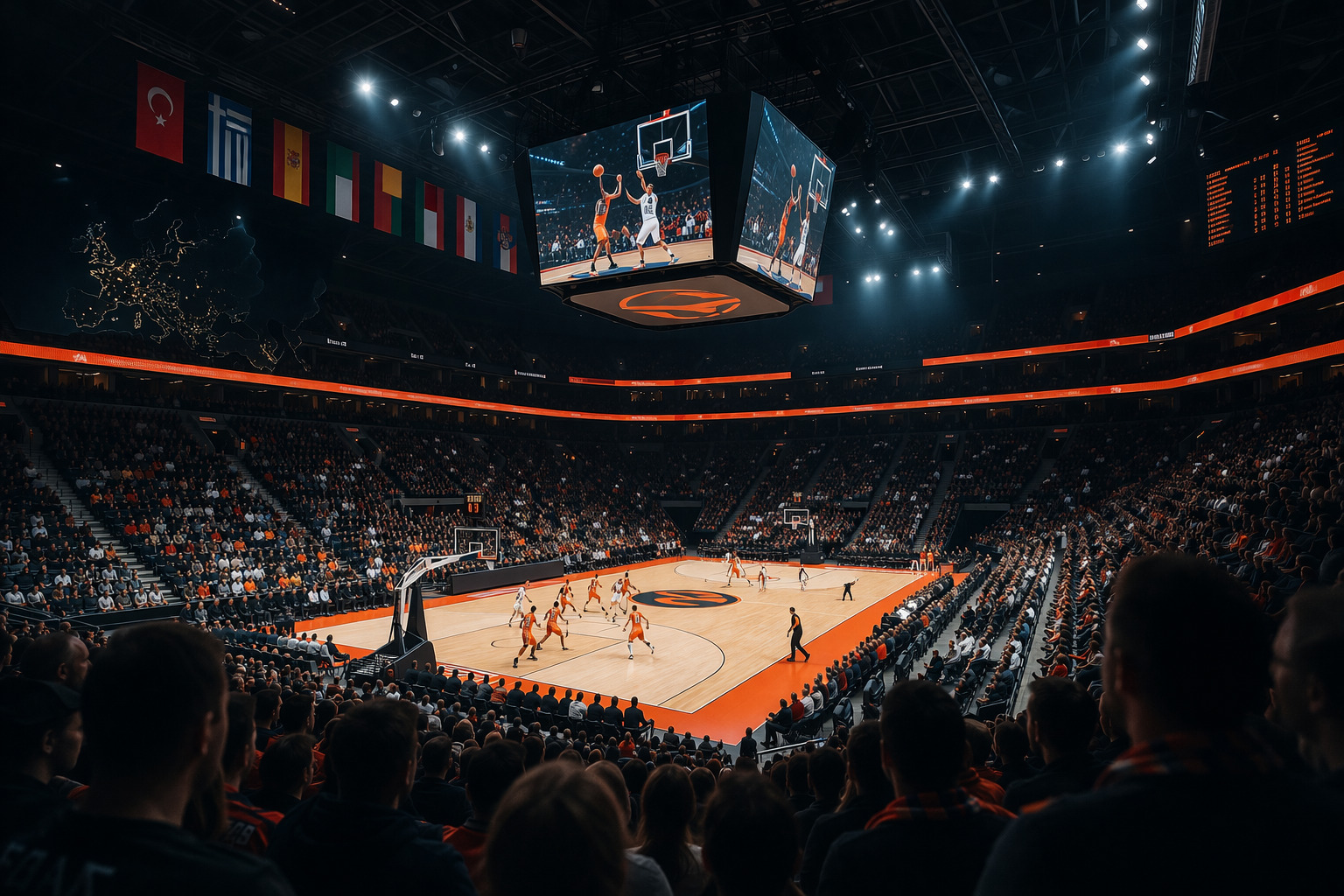
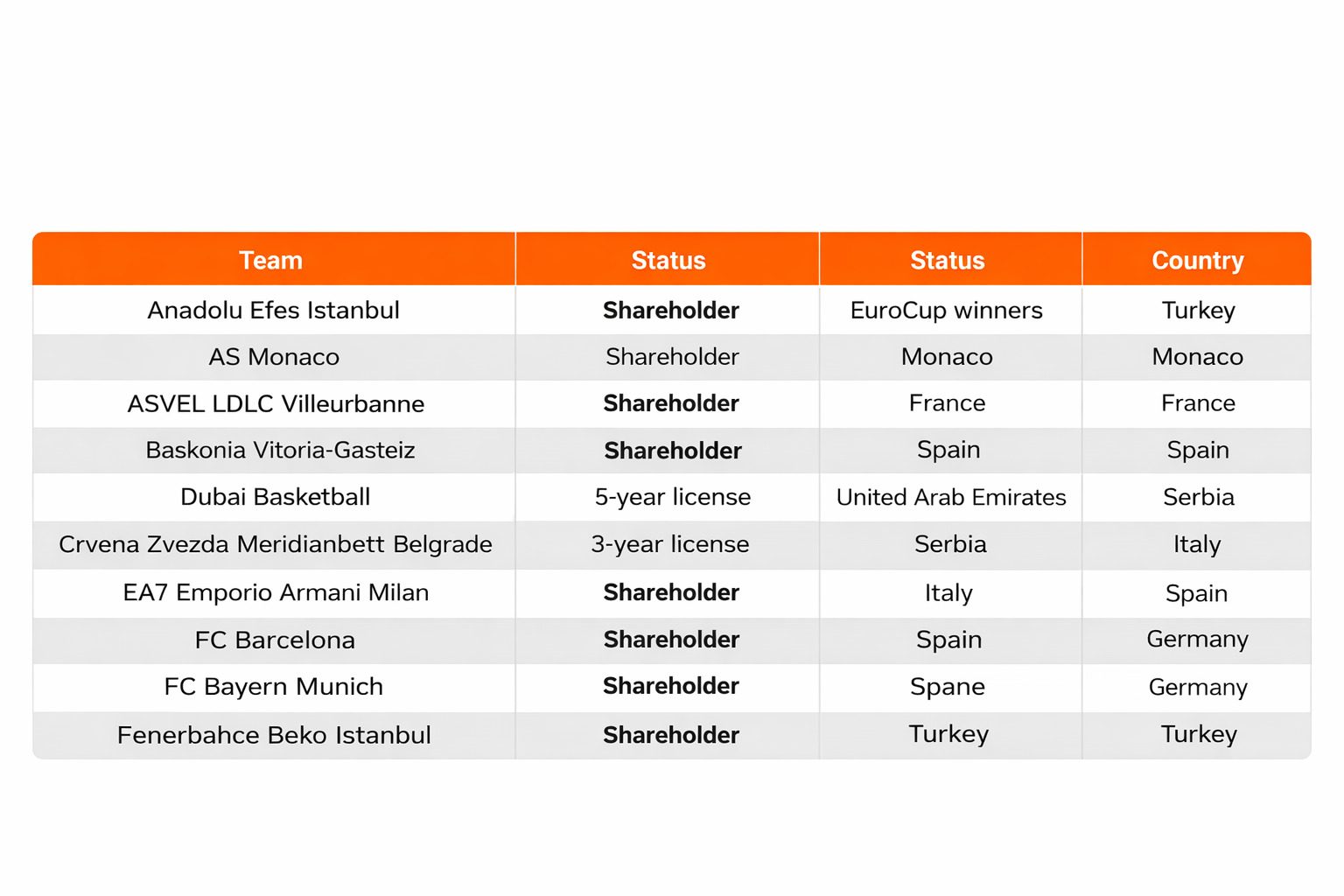
The decision is official — but the implications extend far beyond format.
EuroLeague has confirmed that the 2026–27 season will move forward without structural changes. The competition will retain its 20-team format, along with the same 38-game regular season model that has defined recent years.
At first glance, this reads as continuity.
In reality, it is a strategic pause — a system holding its shape while pressure builds beneath it.
A System That Holds — For Now
The league will once again operate under a double round-robin structure. Each of the 20 teams will face every other club twice — home and away — resulting in a 38-game regular season.
From there, the pathway remains unchanged:
Top 6 teams advance directly to the playoffs
Teams ranked 7–10 enter the play-in stage
The season concludes with the Final Four
This structure has proven effective in terms of engagement, broadcast value, and competitive density. It maximizes inventory — games, content, visibility — while maintaining a clear hierarchy of progression.
But it also comes with a cost.
Travel intensity, compressed schedules, and frequent double-game weeks have turned the season into a sustained endurance test. For players, clubs, and operations, the current model is not just competitive — it is physically and logistically demanding.
And that tension is no longer ignored.
The Illusion of Stability
By keeping the format unchanged, EuroLeague is not rejecting reform.
It is postponing it.
Internally, discussions about structural transformation are already underway. League leadership has openly acknowledged that the current model may not be sustainable in the long term — especially if expansion becomes inevitable.
The core question is not whether change will happen.
It is when.
And under what pressure.
A conference-based system is one of the scenarios under evaluation. But such a shift only becomes viable if the league expands beyond 20 teams — likely to at least 22.
Otherwise, the math breaks.
Fewer games would mean:
Reduced broadcast revenue
Fewer home fixtures
Lower ticketing and sponsorship income
In a league where financial equilibrium is tightly calibrated, even a 25–30% reduction in games could destabilize the ecosystem.
For now, maintaining volume remains the safer strategy.
Teams Confirmed — And Teams in Question
While the format is fixed, the composition of the league remains partially unresolved.
One certainty: Hapoel Tel Aviv B.C. has secured its place in the 2026–27 season after guaranteeing playoff participation this year.
Beyond that, the picture becomes more complex.
Long-Term Stability vs Open Questions
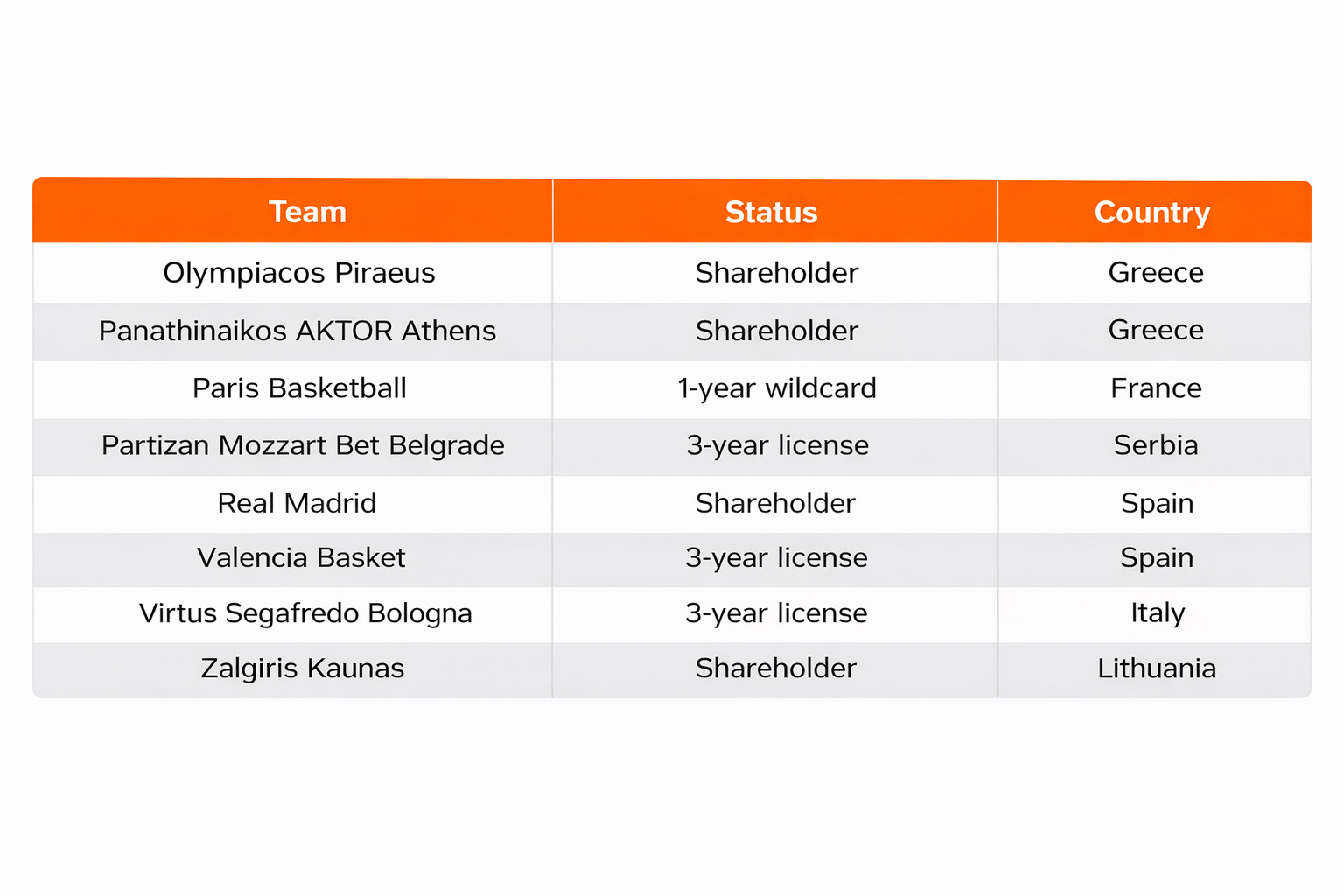
Several clubs operate under stable multi-year agreements:
KK Crvena Zvezda
KK Partizan
Valencia Basket
Virtus Bologna
All are tied to three-year licensing deals signed ahead of the 2025–26 season.
Meanwhile, Dubai’s basketball project operates under a five-year license — a signal of the league’s strategic expansion beyond traditional European markets.
But not all stakeholders are aligned.
Two major shareholders — Real Madrid Baloncesto and Fenerbahçe Beko — have yet to finalize new long-term agreements with the league.
Their positions matter.
They are not just participants — they are structural pillars.
Any hesitation at that level introduces systemic uncertainty.
The Monaco Case: Finance as a Competitive Variable
Few situations illustrate the fragility of the current ecosystem better than AS Monaco Basket.
Despite consistent on-court success — including multiple deep playoff runs and a recent Final Four appearance — the club has faced serious financial pressure throughout the season.
At one point, bankruptcy was narrowly avoided through emergency state intervention.
Legal proceedings related to the club’s financial structure have been postponed until June 12, 2026 — a date that may define its medium-term future.
At the same time, Monaco is actively seeking new investors.
Not just financial backers, but strategic partners — including figures from the NBA ecosystem and global entertainment industries.
This is not incidental.
It reflects a broader shift in how EuroLeague clubs must operate.
Performance alone is no longer sufficient.
Financial architecture has become equally decisive.
Expansion vs Compression
At the center of the current debate is a simple tension that has no simple resolution:
Growth versus balance.
Expansion brings clear advantages — access to new markets, broader commercial exposure, and stronger global positioning. It extends the league’s footprint beyond its traditional core and aligns it with the realities of modern sports economics.
But scale comes at a cost.
Without structural changes, adding teams means adding games — stretching an already dense calendar even further. Travel increases, recovery windows shrink, and operational pressure intensifies.
With structural changes, the equation flips.
Fewer games would protect the schedule, but reduce volume — the very metric that drives broadcast value, ticket revenue, and sponsorship stability. Even a modest reduction can ripple across the entire ecosystem.
This is not just a scheduling issue.
It is a financial model under constraint.
A League Between Two Models
What is taking shape is not just a stable competition, but a system balancing two fundamentally different models of modern basketball.
On one side, a traditional European structure defined by continuity, hierarchy, and long-term participation. In this model, EuroLeague clubs operate within a stable framework where positions are built over time, supported by performance, licensing agreements, and institutional consistency.
On the other, a modern sports ecosystem driven by scale, media value, and expansion. Here, the EuroLeague is not only a competition but a product — one that must adapt to new markets, increase global reach, and align with broadcast and commercial dynamics. Flexibility becomes strategic, not optional.
This tension is embedded in the league’s structure.
Decisions around format, number of teams, licensing, and expansion are no longer isolated. They are interconnected variables shaping how the EuroLeague evolves as both a sporting competition and a commercial platform.
The current format reflects that balance.
It sustains a 20-team structure while leaving space for controlled growth. It protects competitive integrity without closing the door to expansion scenarios. It delivers volume — games, content, visibility — while delaying structural changes that could disrupt revenue flows.
For now, the system holds — not because the question has been resolved, but because the league continues to operate within a narrow corridor where stability and expansion remain in tension, not opposition.
What Comes Next
The 2026–27 season will look familiar — and that is exactly the point. What appears as stability is, in reality, a controlled delay while the league decides how far it can push the current model before it starts to break.
The pressure is already there. The schedule is dense, the number of teams is near its limit, and the question of expansion is no longer hypothetical. At the same time, not all ключевые участники are fully aligned on what the next version of the league should look like.
Keeping the format unchanged is not a conservative move. It is a strategic one. It buys time — to protect revenue, to avoid cutting games, and to prevent changes that could disrupt the balance before a clear direction is agreed.
What comes next is unlikely to arrive as a single, clean reset. More likely, it will unfold step by step — through new teams, adjusted structures, and quiet shifts in how the league positions itself.
Because the real transition is already underway.
It just hasn’t been formalized yet.