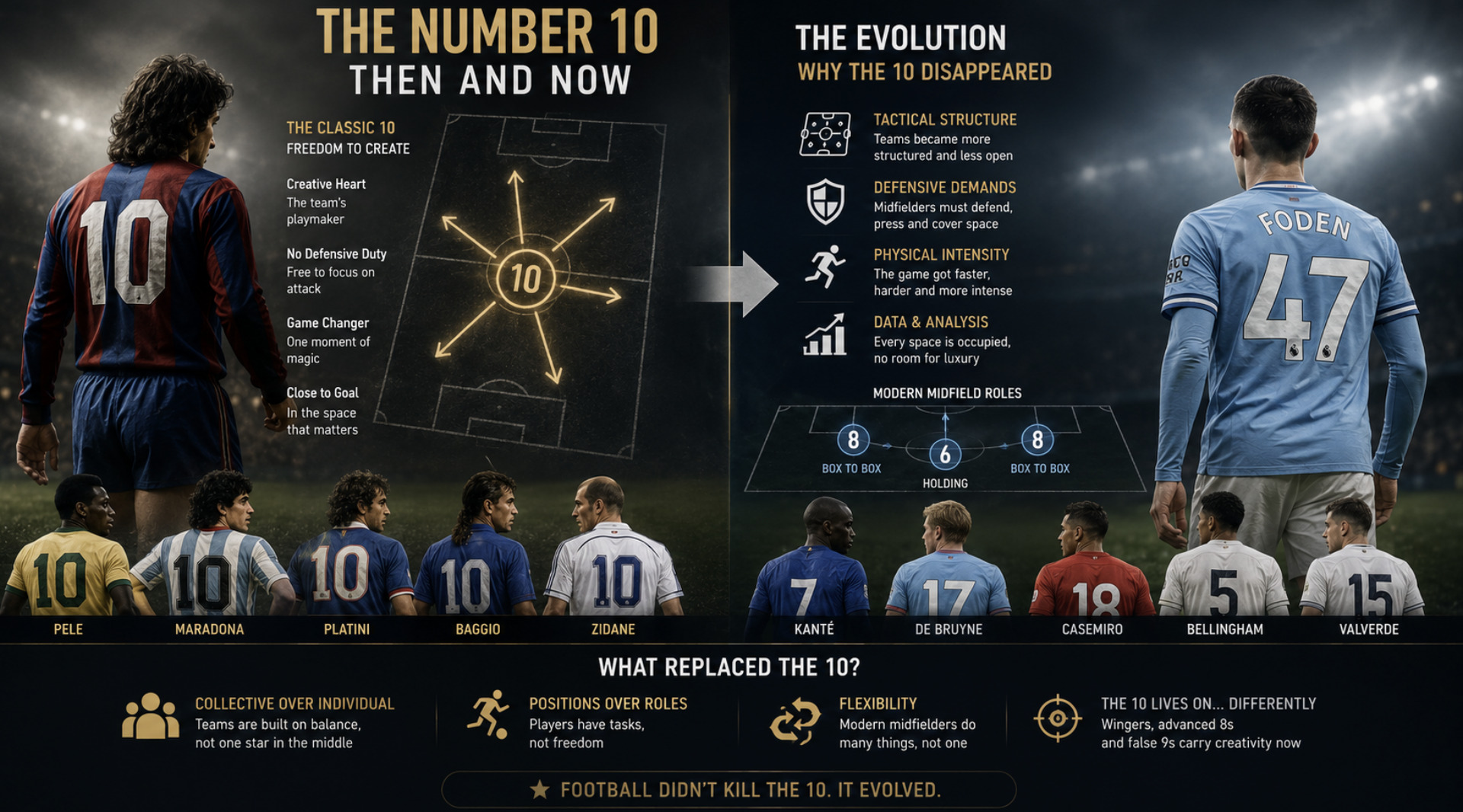
For generations, the number 10 was the most romantic position in football. It belonged to the players who saw passes others could not, who slowed the game down and sped it up at will, who turned matches with a single moment of imagination. The classic 10 was the team's creative heart, freed from defensive duty to do the one thing nobody else could. Yet at the top level that role, in its purest form, has all but disappeared. Understanding why the number 10 evolved — and what replaced it — is one of the clearest windows into how modern football actually works.
The classic playmaker and his kingdom
The traditional number 10 operated in the space between midfield and attack, the pocket behind the striker often called "the hole." From there he was the link between defence and goal, the player every attack passed through. His job was invention: the killer through ball, the disguised pass, the moment of control that unlocked a packed defence. Physicality and pressing were rarely his concern; his value lay entirely in what he did with the ball.
This kind of player thrived in an era when teams defended in deeper, more static blocks and gave the space between the lines room to breathe. A gifted 10 could receive the ball, turn, and pick out a runner before the defence reorganised. Whole teams were built to serve him, feeding him possession and trusting him to produce the decisive act. It was football as theatre, and the number 10 was its lead actor. For a long time, no attacking side was considered complete without one.
Why the pure 10 fell out of fashion
Two tactical shifts slowly closed the space the classic 10 depended on. The first was the rise of intense, organised pressing. As teams began to hunt the ball high up the pitch and collapse quickly on whoever received it, the luxury of standing in the hole waiting for possession became a liability. A player who could not or would not press left his team a man short in the most demanding phase of the game, and that gap was punished at the highest level.
The second shift was the move toward compact, zonal defending that deliberately crowded the very area the 10 wanted to occupy. Midfields grew more disciplined and better drilled at screening the space between the lines, so the pockets that once existed simply closed. A specialist creator who offered little without the ball became a tactical passenger for long stretches. Coaches, forced to choose between artistry and balance, increasingly chose balance — and the pure number 10 began to vanish from elite starting elevens. It is the same tension between beauty and structure that runs through so much of the modern game, a theme we explore in How to Read a Football Match Like a Coach.
Where the creativity went
Creativity did not disappear; it was redistributed. Rather than concentrating invention in one static player, modern teams spread playmaking across several positions. The deep-lying playmaker, sitting in front of the defence, now dictates tempo and threads long passes from a base where there is more time on the ball. Full-backs and wing-backs push high and provide width and crosses that once came from central areas. Attacking midfielders are asked to create and to press, blending the old 10's vision with a runner's engine.
Perhaps the most important heir is the wide forward who drifts inside. Many of the game's best creators now start from the flank and move into central pockets, arriving in the dangerous zone with momentum rather than standing in it. This gives teams the invention of a 10 without sacrificing the pressing and running that modern systems demand. Creativity, in other words, became a collective responsibility rather than the gift of a single specialist — harder to mark, harder to isolate, and far better suited to the physical intensity of the current game.
The modern hybrids that replaced it
The players who most resemble old number 10s today are hybrids who would have been unrecognisable to earlier generations. They combine the passing range and imagination of a classic playmaker with the stamina, defensive work rate and goal threat of a complete midfielder. They press from the front, cover ground box to box, and still produce the decisive pass or finish. The role is no longer defined by where a player stands but by what he contributes across every phase.
This is why the modern attacking midfielder is often measured as much by pressures, sprints and goals as by assists. The position rewards those who can do everything, and the few who genuinely can are among the most valuable players in the world. The number 10 shirt still exists, and it is still handed to a team's most creative figure, but the job attached to it has changed beyond recognition. Standing still and waiting for the game to come to you is no longer an option, even for the most gifted.
What the change tells us about football
The evolution of the number 10 is a story about how tactics shape talent. Nothing about human creativity changed; what changed was the environment it had to survive in. As pressing intensified and defensive organisation improved, the game stopped rewarding players who offered only invention and started demanding that everyone contribute in and out of possession. The specialist gave way to the all-rounder, not because artistry lost its value but because artistry alone was no longer enough.
There is a quiet nostalgia among many supporters for the classic playmaker, the player who could win a match without ever breaking sweat defensively. That figure may never fully return in his old form, but his spirit lives on, scattered across deep midfielders, inverted wingers and box-to-box creators who carry the burden of invention while doing far more besides. The number 10 did not die. It evolved into something more demanding, more collective and, in its own way, just as compelling to watch.