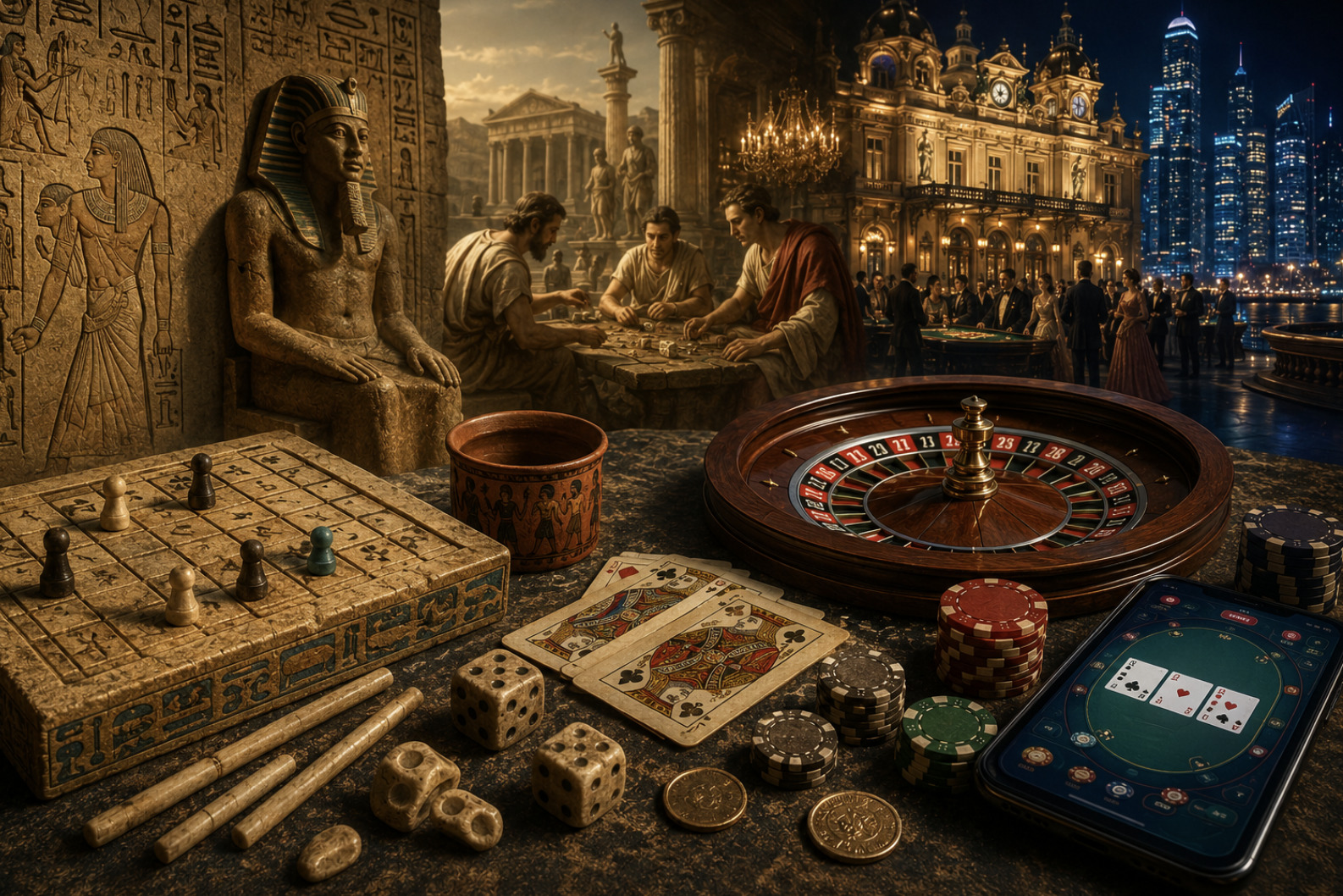
Long before a roulette wheel ever spun or a card was ever dealt, the people of the Nile were already wagering on the fall of a stick and the favour of fortune. Gambling in ancient Egypt is one of the oldest threads in the entire human story of risk and reward, and it runs straight through the centre of Egyptian life — from the dust of village courtyards to the painted walls of royal tombs. The Egyptians did not separate luck, fate, and the divine the way we do. To them, a random outcome was not empty chance. It was a message, and the board on which it landed was a place where mortals and gods could, for a moment, sit on the same side of the table.
That idea is captured perfectly in one of Egypt's own myths. The sky goddess Nut had been cursed so that she could not give birth on any day of the year. The wisdom god Thoth solved the problem the way an Egyptian might have expected a clever god to solve anything — he gambled for it, winning slivers of light from the moon in a game of chance until he had assembled five extra days outside the calendar on which Nut could finally bear her children. The first recorded high-stakes wager in Egyptian thought, in other words, was a god playing the odds to bend time itself.
Senet: the world's oldest game of chance
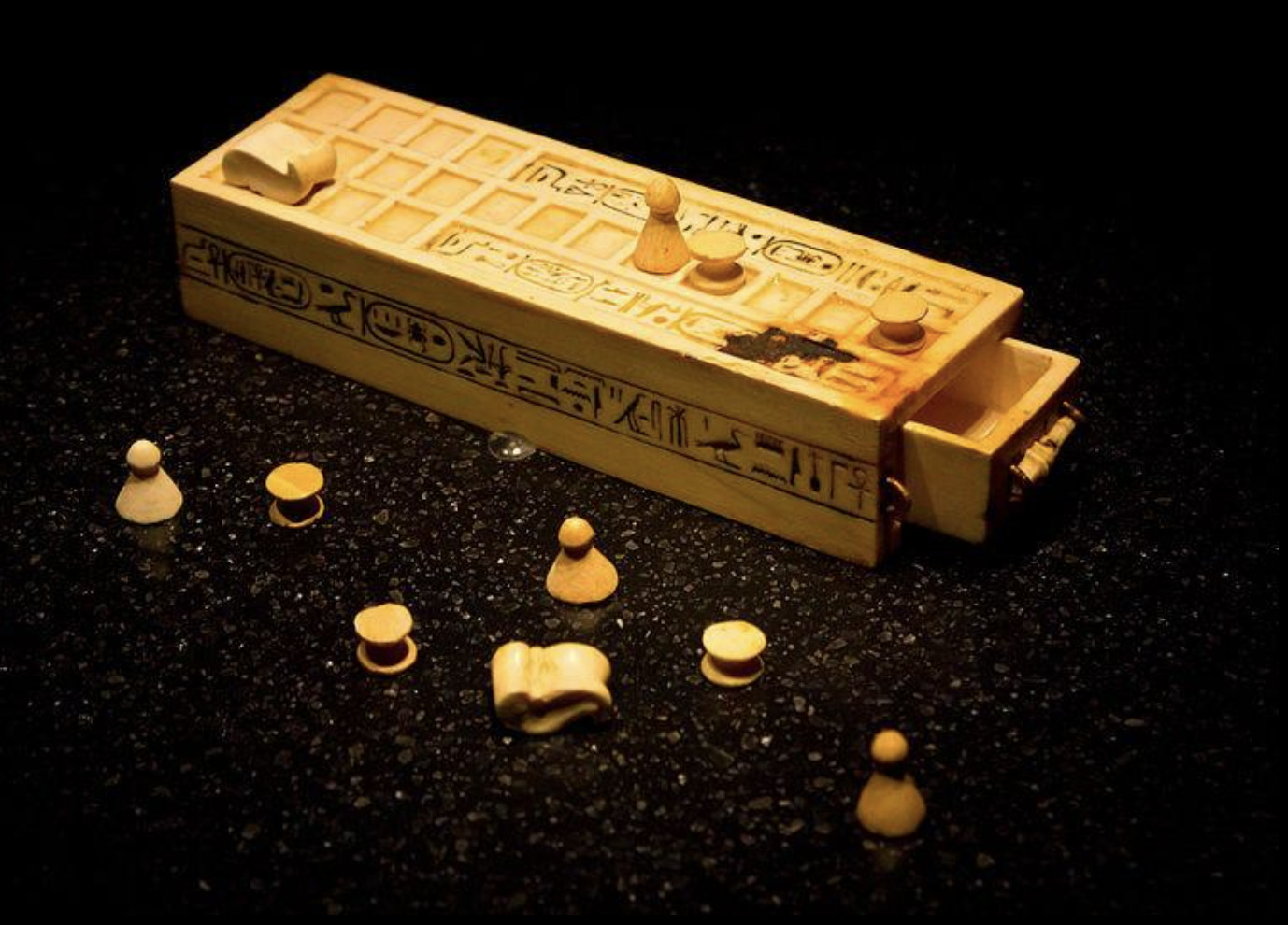
If gambling in ancient Egypt has a single beating heart, it is Senet. Evidence of the game stretches back to roughly 3500–3100 BCE, in the Predynastic and Early Dynastic periods, which makes it one of the oldest board games ever found anywhere on earth. Archaeologists have recovered Senet sets from humble graves and from the tombs of pharaohs alike, and painted Senet boards appear on tomb and temple walls across thousands of years of Egyptian history.
The board itself was elegant and simple: thirty squares laid out in three rows of ten, with the pieces of two opposing players threading a long, snaking path from one end to the other. The goal was to move all of your pawns off the board before your opponent did. What made it a game of chance rather than pure strategy was the way players generated their moves. There were no cubic dice in early Egypt. Instead, competitors threw flat casting sticks — painted on one side, blank on the other — or tossed knucklebones, and counted the result to decide how far a piece could advance. Every turn began with a small act of submission to luck.
We cannot prove with certainty what was staked on a game of Senet, partly because Egypt did not use coined money until the very late, Greek-influenced periods. But the structure of the game, the universal human urge behind it, and the company it kept all point the same way: Senet was very likely played for stakes of goods, pride, and standing, the way people have wagered on contests in every age since.
Throwing sticks, knucklebones, and the birth of the die
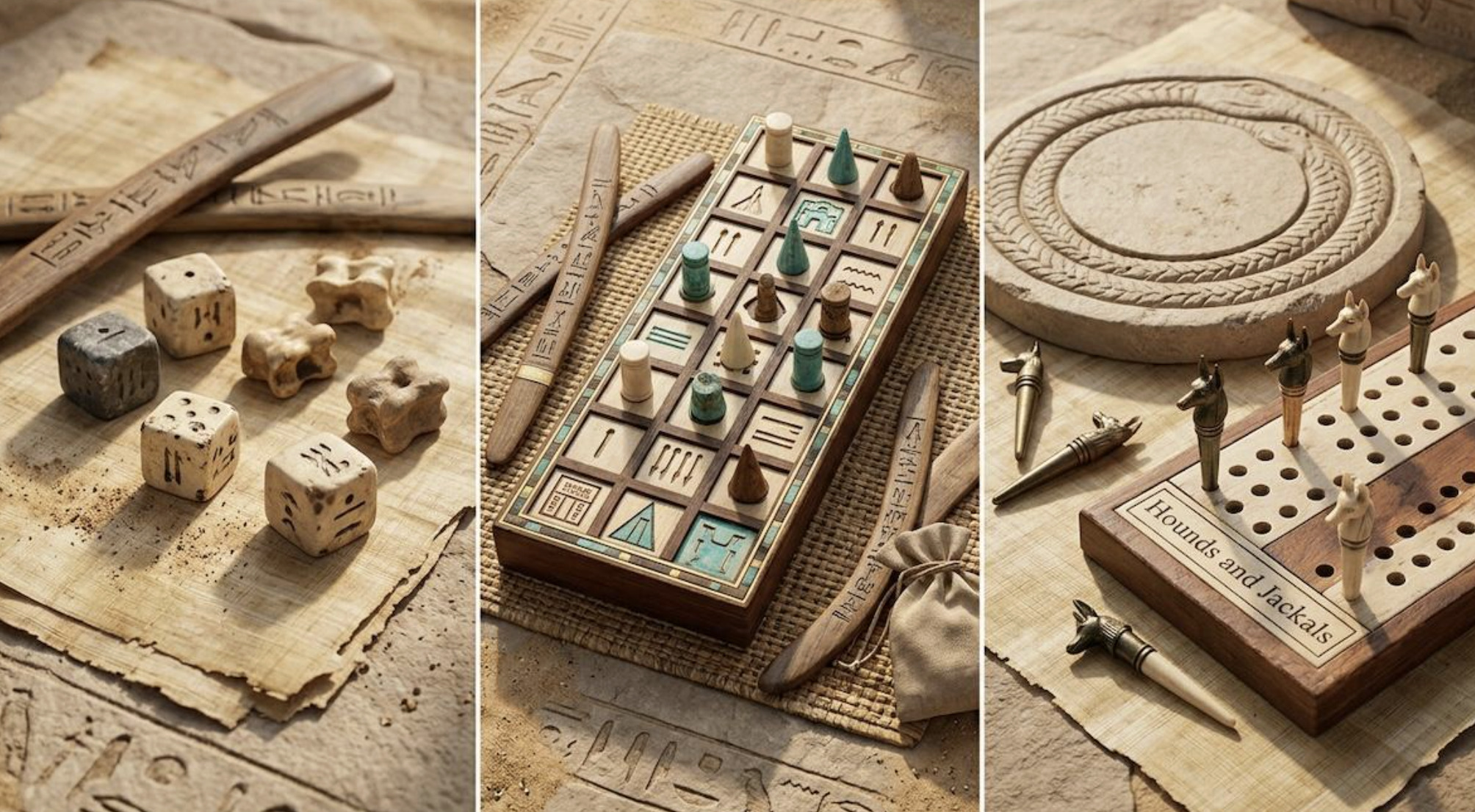
The randomising tools of Egyptian play deserve their own moment, because they are the direct ancestors of every die ever rolled. The throwing sticks used in Senet worked like a handful of two-sided coins flipped at once, the count of painted faces giving the move. Alongside them came the astragali — the small ankle bones of sheep and goats. An astragalus has four distinguishable sides, each of slightly different shape and each assigned a different value, which effectively makes it a rough four-sided die produced by nature rather than a craftsman.
These bones were shared across the ancient Mediterranean and Near East, used both for play and for divination, and the line between the two was thin. To throw the bones and read the result was, in many cultures, to ask the gods a question. The familiar six-sided cube we now picture when we say "dice" arrived in Egypt comparatively late, becoming common only in the Ptolemaic and Roman eras, by which point Egyptian gaming had absorbed Greek and wider Mediterranean influences. The instinct underneath, though, never changed: take an object whose landing you cannot control, and let it speak.
Playing the gods: Senet and the journey through the afterlife
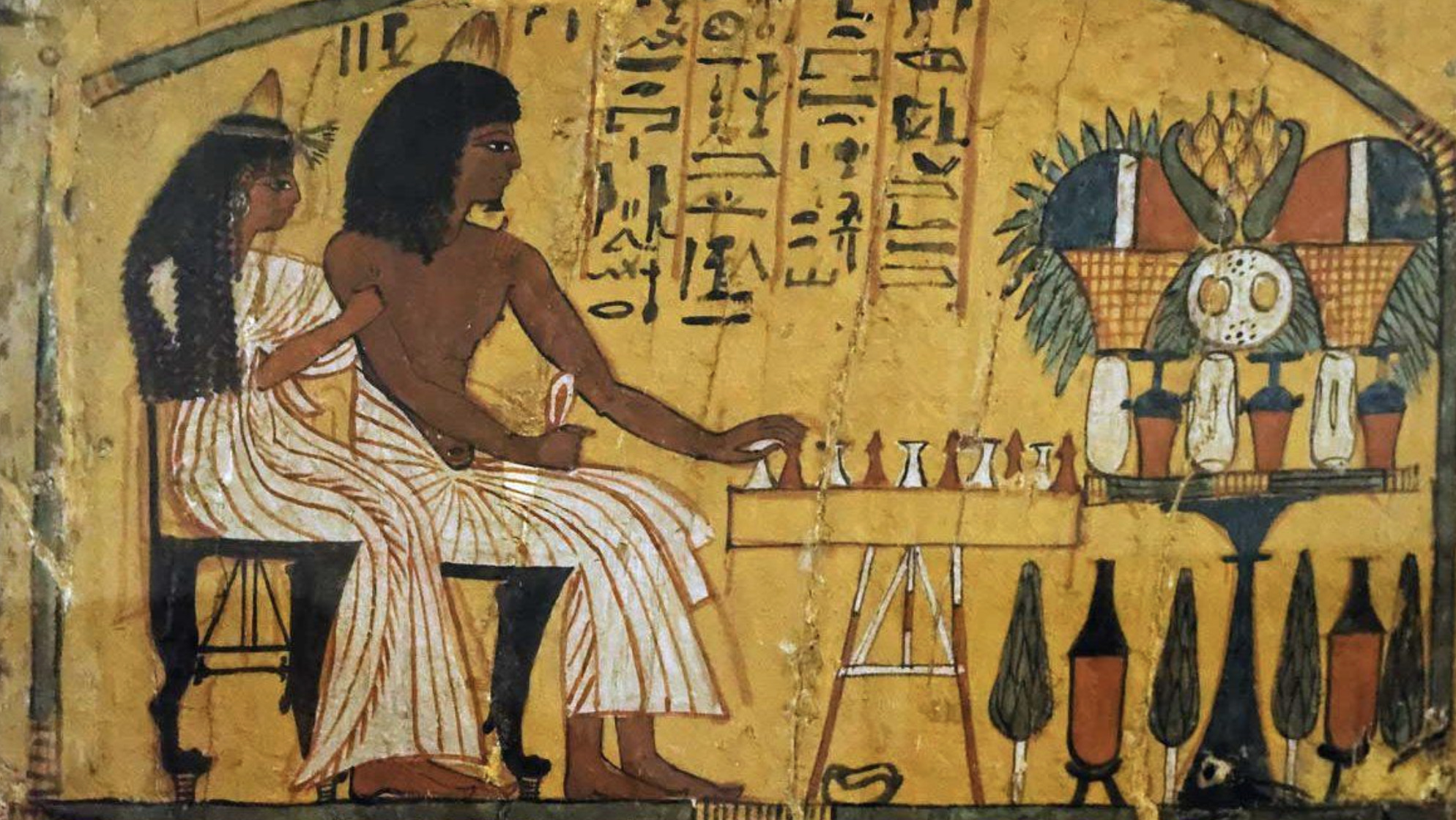
By the New Kingdom, Senet had grown into something far larger than a pastime. It became a map of the soul's passage into the next world. Spell 17 of the Book of the Dead and a series of famous tomb paintings show the deceased seated at a Senet board, playing against an opponent who is never shown — an unseen rival standing in for fate, the gods, or death itself. To win the game was to win safe passage through the Duat, the dangerous underworld, and into eternal life.
The most beautiful surviving example sits in the tomb of Queen Nefertari, the great wife of Ramesses II, where she is depicted gracefully playing Senet alone, contesting her own immortality square by square. King Tutankhamun was buried with several Senet sets among his treasures, equipment for the afterlife as much as for an idle hour. In this light, the Egyptian relationship with games of chance reveals its true depth. The fascination with uncertainty, fortune, and outcomes determined by forces beyond immediate control has proved remarkably persistent across human history. From sacred lots and medieval lotteries to modern probability models and contemporary gaming platforms such as Realz, people have repeatedly returned to activities that transform uncertainty into a structured experience. The same throw of the sticks that decided a friendly match in life was imagined to decide the ultimate wager after death. Gambling, fate, and faith were braided into a single rope.
Beyond Senet: a culture that loved a wager
Senet was not alone. The Egyptians also played Mehen, the "snake game," on a coiled, spiral board, and a hunt-themed game often called Hounds and Jackals — a board of fifty-eight holes into which pegs were moved according to the throw of sticks. These games crossed every social boundary. The same basic pleasures occupied labourers resting from building projects and queens reclining in palace chambers, which is one reason Senet boards turn up scratched casually into stone in workmen's areas as readily as they appear gilded in royal burials.
This breadth matters for understanding gambling in ancient Egypt. It was not a vice tucked into a shadowy corner of society. It was woven into ordinary leisure, into courtship and rivalry, and into the most sacred ideas about death and what comes after.
What "gambling" really meant on the Nile
It is worth being honest about the limits of the evidence. Egyptian gaming sat at a crossroads of entertainment, competition, and divination, and we should resist the temptation to dress it up as a fully formed casino culture. There were no betting houses along the Nile, no fixed odds, no croupiers. What there was, unmistakably, was the core of gambling itself: a contest decided in part by a random throw, charged with meaning, and almost certainly played for something that mattered to the people throwing.
That is the thread worth holding onto. The Egyptians invented neither luck nor greed, but they were among the first to build the act of risking an outcome into both their daily play and their vision of eternity. Every modern game that turns on a roll, a spin, or a shuffle is, in a distant sense, still playing on the board that Thoth, Nefertari, and a thousand forgotten villagers once shared — and still, on some level, asking the same old question of fate.