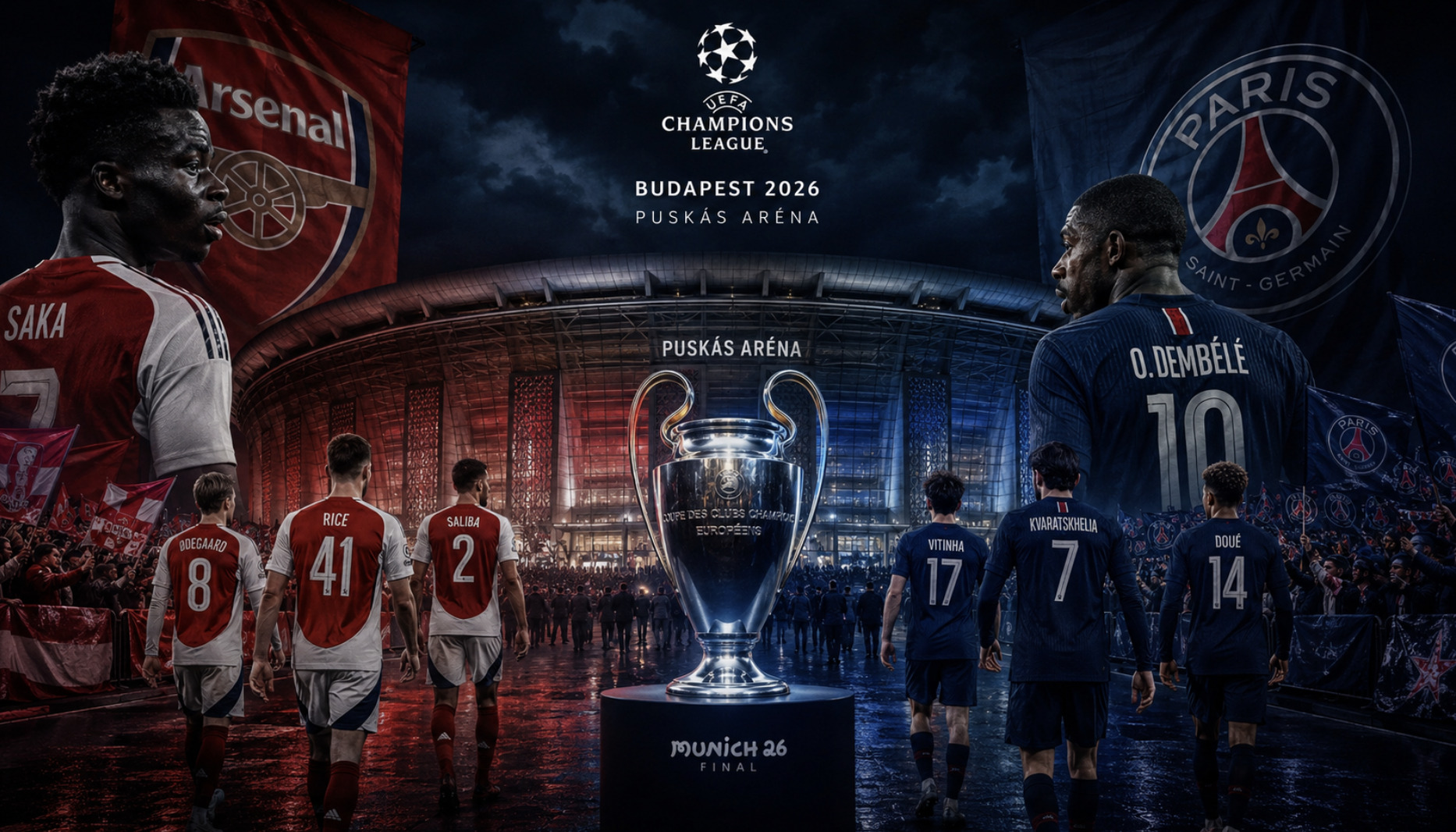
If you had said in January 2025 that the next two Champions League finals would feature Paris Saint-Germain as defending European champions and Arsenal as the team finally returning to the showpiece for the first time in twenty years, nobody who follows the sport seriously would have laughed — but a great many of them would have asked you to explain your work. PSG were a side that had become a punchline for big European nights despite a decade of state-backed spending. Arsenal had spent the better part of the same decade in a controlled, patient rebuild that had produced a domestic identity but never a serious European one. The two clubs were not merely on different paths; they were widely understood to be on opposite ones.
On Saturday in Budapest, those paths arrive at the same fixture. The 2026 Champions League final at the Puskás Aréna is not, as some of the early framing has suggested, a contrast between a superclub and a project. It is the inverse. It is the meeting of two projects, run on radically different fuels, that have both — slowly, almost quietly — become the most coherent teams in their respective leagues. Here is what is actually at stake on Saturday, beneath the narrative scaffolding.
How they got here, and why the journeys matter
Arsenal's route has been the more straightforward of the two to read. Mikel Arteta's side beat Atlético Madrid 2-1 on aggregate in the semi-finals to seal qualification, having earlier dispatched Sporting CP and Bayer Leverkusen on the way through. None of those ties were comfortable. None of them were chaotic either. The recurring feature of Arsenal's continental run has been the same thing that has defined Arteta's whole project at the club: a refusal to be pulled out of shape, even by opponents whose plan is specifically to pull them out of shape.
PSG's path has been more dramatic and, in places, more contested. The semi-final against Bayern Munich produced one of the most argued-about results of the season, a 1-1 draw at the Allianz Arena that was enough on aggregate but that left most of the post-match analysis revolving around whether the tie should have ended differently. Earlier in the tournament, Luis Enrique's side had moved through the bracket with the same set of features that has made them so difficult for Ligue 1 to defend against — quick, vertical, technically immaculate transitions, the ball played forward at the speed older European football used to keep it for a few touches longer.
The two journeys have produced two finalists who arrive in Budapest with the same record (eleven wins from twelve UCL knockout legs combined) but who got there by doing almost opposite things. Arsenal won by control. PSG won by movement. That contrast is the entire pre-match.
The story Arsenal is finally getting to tell
Twenty years is the kind of number that sounds heavier than it is until you sit with it. Arsenal last reached a Champions League final in 2006, at the Stade de France against Barcelona, in the Henry-Vieira-Lehmann era that has long since passed into club mythology. The team that lines up in Budapest contains no overlap with that side and no overlap with the project the club tried to launch repeatedly between then and now. Arteta's tenure, which began in late 2019, has been the first one at the club since Wenger's departure that has produced a recognisable footballing identity at a continental level rather than just a domestic one — and the identity it has produced is exceptionally rare.
Saka, who carries the right-side burden in this team, is the most visible expression of it: a winger who functions as a structural piece rather than a moment generator, whose contribution is measurable in the spaces he opens for the midfield runners as much as in his own goal involvements. Around him, the project that Arteta and Edu built — Saliba and Gabriel as the spine, Rice as the connector, Ødegaard as the conductor when fit, Trossard and Martinelli on the other flank — has reached the point at which the team's structural intelligence is itself the dangerous thing. Opponents are not breaking Arsenal down because the structure does not let them. Opponents are also not breaking Arsenal apart from above, because the press has been engineered to keep them on the ball just long enough to die slowly rather than fast.
This is the team Arteta has been building toward since 2019. Saturday is the first night on which the project gets to test itself against a side that is, by most informed reckonings, the best in Europe at exactly what Arsenal are best at preventing.
What PSG actually are without Mbappé
The narrative that PSG won the 2025 Champions League "after Mbappé left" was widely shared and partially accurate. The fuller truth, which has gradually become more visible across this season, is that PSG won the 2025 Champions League because Mbappé left — and that they have spent the season since constructing a team that is, in tactical terms, much harder to defend against than the superstar-led PSG ever was.
Luis Enrique's project, in its current form, is built on three principles that the old PSG could not have executed. First, possession is the means rather than the end: the ball is moved quickly and forward, with positional rotations designed to break the opposition's first line rather than admire it. Second, the front three is interchangeable to the point of being almost a rumour; Dembélé, Kvaratskhelia and Doué can each occupy the central position, the left half-space, or the right-side overload, and the opposition's centre-back pair is asked to read which configuration is operative at any given second. Third, the midfield — Vitinha, João Neves, Fabián Ruiz — is the engine, not the support. The pivot does not feed the stars. The pivot decides what the stars become.
The Mbappé-era PSG was a team in which one player carried the burden of converting a brilliant supporting cast into results. The current PSG is the inverse: a system in which the cast itself is the structural answer, and any single match-winner is, in effect, plug-and-play. That is a much harder team to scout. It is also, less appreciated, a much harder team to fall behind to, because there is no single hot streak to weather.
The tactical question Saturday actually poses
Strip away the narrative storylines and the question on the pitch in Budapest is genuinely interesting in tactical terms, in a way most recent UCL finals have not been. Arsenal's strength is structural compactness — the ability to keep eleven players in their assigned relationships under pressure, and to refuse to be drawn out of shape by movement that would punish other teams. PSG's strength is precisely the movement that would punish other teams. The two strengths are pointed directly at each other.
Three sub-questions will decide it.
First, who controls the half-spaces. Arteta's side defends the half-spaces with two midfielders shifting in synchrony with the back line, conceding the touchline in exchange for closing the lanes inside. PSG's attacking pattern is built around making the inside lanes operate even when the touchline is open. The team that wins the half-space battles in the opening twenty-five minutes will likely win the match.
Second, what happens when Arsenal break the press. PSG do not press like an Italian side or a German one; they press with the same vertical principle that defines their attack, in short, intense sequences designed to win the ball forward. When they fail — and against an opponent as composed on the ball as Arsenal, they will fail sometimes — they leave space behind the midfield that the right ball can exploit. Arsenal have one of the best right-sided combinations in Europe at exploiting exactly that kind of space. If Saka and Ødegaard get four or five clean transitions in the first half, the night gets very interesting.
Third, who blinks under set-piece pressure. Arsenal have built one of the most lethal set-piece operations in the modern game, by careful design under their dedicated set-piece coach. PSG's response to corners and dead-ball deliveries has been their most-criticised defensive feature all season. If the match is tight at sixty minutes, the next corner is not a neutral event.
What the markets see, and what they sometimes miss
Pre-match markets have settled with PSG as the slight favourites — broadly in the -110 to -125 range across most lines this week, with Arsenal sitting around +250 and the draw priced as you would expect for a final between two well-matched sides. The implied probability is honest: this is a coin-flip with the coin weighted very slightly toward Paris.
What that line obscures is one specific feature of the matchup. Markets are excellent at pricing the average outcome of a finite distribution. They are less good at pricing what happens when one side's strength is the precise inverse of the other's. Arsenal's structural defence has, this season, produced outlier results against teams that play through movement — most notably against Atlético, whose attack relies on patterns Arsenal closed down systematically. PSG are not Atlético; their movement is quicker, their personnel more dangerous, and their patience higher. But the kind of question they will ask is the kind Arsenal have been answering all season. The market is pricing a slightly favoured PSG. The match is closer to a true toss-up than that.
What this means beyond Saturday
For Arsenal, a win in Budapest does not retrospectively justify Arteta's project — the project was already producing what it was designed to produce. It would, however, mark the moment at which the club's long-term planning finally outran its long-term scepticism. The patience trade has been the entire bet of Arsenal's modern era. Saturday is the night the bet either cashes or has to be explained again.
For PSG, a successful defence would mean something different. It would make Luis Enrique's side the first team since Real Madrid in 2017 and 2018 to win back-to-back European Cups, and the first French club ever to do it. It would also confirm, more or less definitively, that the post-Mbappé tactical project is not a one-season aberration but the actual identity of this PSG, and that the next decade of Ligue 1 might be the first one in modern memory in which Paris are a European force every year rather than every third year.
Both possibilities are real. The two projects have, in different ways, taken almost a decade to arrive at Saturday. The thing about Champions League finals is that they do not care about how long the project took. They care about the next ninety minutes. Budapest, 18:00 CEST. The waiting ends.