Start with the number: six of the thirty-two NFL starting quarterback jobs will be filled by different players in 2026 than they were at the start of 2025. That kind of turnover — almost one in five starting positions changing hands in a single offseason — is rare. It produces realignment. It creates genuine uncertainty at the position that defines the outcome of every NFL season more than any other. And in 2026, it arrives in the same offseason as the most consequential individual quarterback story the league has had since Brett Favre retired.
Patrick Mahomes tore his ACL and LCL on December 14, 2025, against the Los Angeles Chargers, in a game that simultaneously eliminated the Kansas City Chiefs from playoff contention for the first time since 2014. He was thirty years old. He had made the AFC Championship Game in every one of his seven seasons as a starter. And now, in a league where no quarterback has ever returned from a torn ACL and LCL and immediately recaptured his previous level — not Brady, not Favre, not Rodgers — the question that will define the 2026 NFL season is simple: what version of Patrick Mahomes comes back?
Everything downstream of that question shapes the power structure of the AFC and, by extension, the championship odds for every serious contender in the league.
The Mahomes Situation: What We Know and What We Don't
The optimism coming out of Kansas City is genuine and, so far, evidence-based. GM Brett Veach described Mahomes as "way ahead of schedule" in early May. Adam Schefter confirmed on Get Up that Mahomes is tracking to be ready for the September 14 opener against Denver on Monday Night Football. The video of Mahomes throwing at his charity golf tournament in Las Vegas — compression sleeve on the left knee, full throwing motion, no visible hesitation — made the rounds and was interpreted by former QBs as a positive sign.
Mahomes suffered a torn ACL and torn LCL on December 14, 2025, and according to ESPN's Adam Schefter, there is a realistic chance he will be in the lineup for the Chiefs' season opener.
But Schefter added a caveat that matters: "Is he gonna be 80%, 90%, 100%? Like that's hard to imagine that he could just step in there right away after such a significant knee injury and pick up right where he left off and be as great as he's always been."
That calibration is the right one. The question is not whether Mahomes plays in Week 1 — barring a setback, he probably does. The question is what version plays. ACL-LCL combination injuries are more severe than isolated ACL tears. The LCL affects lateral stability, which is directly relevant for a quarterback whose mobility and pocket movement are central to his game. Mahomes tore both the ACL and LCL in his left knee, finishing the 2025 season with 3,587 passing yards, 22 touchdowns and 11 interceptions before the injury. Those 2025 numbers, notably, were already below his historical average — the injury came in a season that had already been a struggle.
For betting purposes and for fantasy purposes, the Mahomes situation is the most volatile individual variable in the entire 2026 NFL landscape. A Mahomes returning at 85% is still a top-ten quarterback. A Mahomes who comes back and immediately regains all his pre-injury mobility is the best player in the league. The difference between those outcomes is enormous for Kansas City's chances and for the AFC picture.
The Chiefs will open with six primetime or standalone games on the 2026 schedule — the league and its TV partners betting that the Mahomes return story is a ratings magnet regardless of what the product looks like. They are correct. It will be.
The Quarterback Carousel: Biggest Moves of the Offseason
Beyond Mahomes, the 2026 offseason has produced a series of quarterback moves that individually range from interesting to genuinely significant.
Aaron Rodgers, Pittsburgh → Retirement Announcement (2026 season as his last)
The most consequential domino of the post-draft landscape: Rodgers announced in May that the 2026 season will be his final one. He is under contract in Pittsburgh, he will start, and the Steelers have built around him aggressively — acquiring DK Metcalf last offseason and Michael Pittman Jr. this cycle in a $59 million deal. Seventy-six percent of Rodgers' pass attempts went under 10 air yards last season, the highest rate in the league — Pittman's short-route running makes him a natural fit for this system.
Rodgers-as-lame-duck creates an interesting dynamic in Pittsburgh. The Steelers have young quarterbacks on the roster — Will Howard and Drew Allar — who will be watching a forty-something starter operate with the explicit knowledge that this year is his last. The pressure on the organization to build a winning environment around Rodgers in his final year while simultaneously identifying his replacement is real. It is also the kind of franchise-level management challenge that Pittsburgh has historically done worse than its reputation suggests.
Tua Tagovailoa, Miami → Atlanta Falcons (1 year, $1.3M)
In terms of investment versus potential return, this might be the smartest move of the entire offseason. With Miami releasing Tagovailoa and carrying all of his dead money, the Falcons were able to land the veteran starter for the minimum. Michael Penix Jr., the eighth overall pick in 2024, suffered a torn ACL in November and will likely be recovering right up to or through the start of the season.
The Tua signing is fascinating because it creates a genuine quarterback competition in Atlanta, with very different risk profiles attached to each player. Penix, if he returns healthy and the 2024 numbers were a floor rather than a ceiling, is the long-term answer. Tagovailoa, who has led the league in completion rate, passing yards, and touchdown rate in three different seasons depending on which season you look at, is a starting-calibre player available for the minimum because of the concussion history and cap situation that forced Miami's hand. The Falcons are getting legitimate value in either direction.
Malik Willis, Miami Dolphins
Miami's Tagovailoa release left them thin at quarterback, and the solution was Willis — a player who showed genuine mobility and arm talent during his starts in Tennessee but who has never demonstrated consistent pocket efficiency. The Dolphins have offensive weapons (Tyreek Hill, Jaylen Waddle traded to Denver, Terron Armstead) and a system that needs a quarterback who can process quickly. Willis's process is the legitimate question mark. Miami is betting on development. It's a high-variance bet.
Justin Fields, Kansas City Chiefs (acquired from Jets)
The Chiefs acquired Justin Fields from the Jets for a future sixth-round pick, with New York paying a large portion of Fields' salary. This move is specifically about insuring the Mahomes return. If Mahomes is not ready for Week 1, or if the knee issue recurs mid-season, the Chiefs need a quarterback who can run their system rather than simply manage games. Fields — whose rushing ability and arm talent were never in question, whose processing and consistency were — gives Kansas City that insurance. He is a better bridge option than Gardner Minshew was last December.
The Division-Level Power Shifts
The quarterback changes do not occur in isolation. They reshape division dynamics in ways that have second-order effects on the entire playoff picture.
AFC West is the most changed division in football. The Chiefs went 6-11 in 2025 and missed the playoffs. The Denver Broncos are the defending Super Bowl champions — Bo Nix won Super Bowl MVP with Kenneth Walker III in the backfield. Denver has now added Jaylen Waddle to give Nix a legitimate elite target. The 2026 season opens September 14 with Chiefs at Denver on Monday Night Football — the defending champions hosting the team that missed the playoffs last year, whose quarterback is returning from a major knee injury. If that game does not have significant national television interest, no game will.
The Chargers are the wild card. They eliminated Mahomes in the game where he was injured. Their pass rush was the direct cause of the Chiefs' season ending. The Western divisional race in 2026 is genuinely three-team with a healthy Mahomes, and potentially two-team without him.
NFC — The 49ers Are Back in the Top Five. Mike Evans signing with San Francisco is the receiver-suite move of the offseason for a team that already has Deebo Samuel and Brandon Aiyuk. With Brock Purdy operating a Kyle Shanahan system that consistently produces top-five passing efficiency, adding Evans at this stage of his career as a possession receiver who can make plays downfield is an intelligent move. The 49ers were a Super Bowl contender before this. They remain one.
The Seahawks Enter 2026 as Defending Champions. Seattle's Super Bowl win with Kenneth Walker III — who walked in free agency to the Chiefs — forces the Seahawks to solve a running back need while protecting a championship nucleus. Buffalo acquired DJ Moore from Chicago in a move that gives Josh Allen his best receiving complement since Stefon Diggs. The AFC East picture is genuinely crowded.
The Draft Impact: Fernando Mendoza and the Raiders' Reset
The 2026 NFL Draft provided the other major story of the quarterback landscape — specifically the Las Vegas Raiders, who moved on from their starter to clear the path for projected number-one overall pick Fernando Mendoza.
The move paves the way for projected No. 1 overall pick Fernando Mendoza to step in as the Day 1 starter for the Raiders next season.
Mendoza entering a Raiders franchise that has been in quarterback transition for years is either the beginning of an era or the continuation of a pattern, depending on how the front office builds around him and how quickly the offensive line improves. The Raiders were one of the league's worst teams in 2025. Mahomes, Nix, Chargers — the AFC West schedule is a difficult development environment for a rookie quarterback. Mendoza will need wins on the board within the first eight games or the fanbase patience will be limited.
The Odds Board
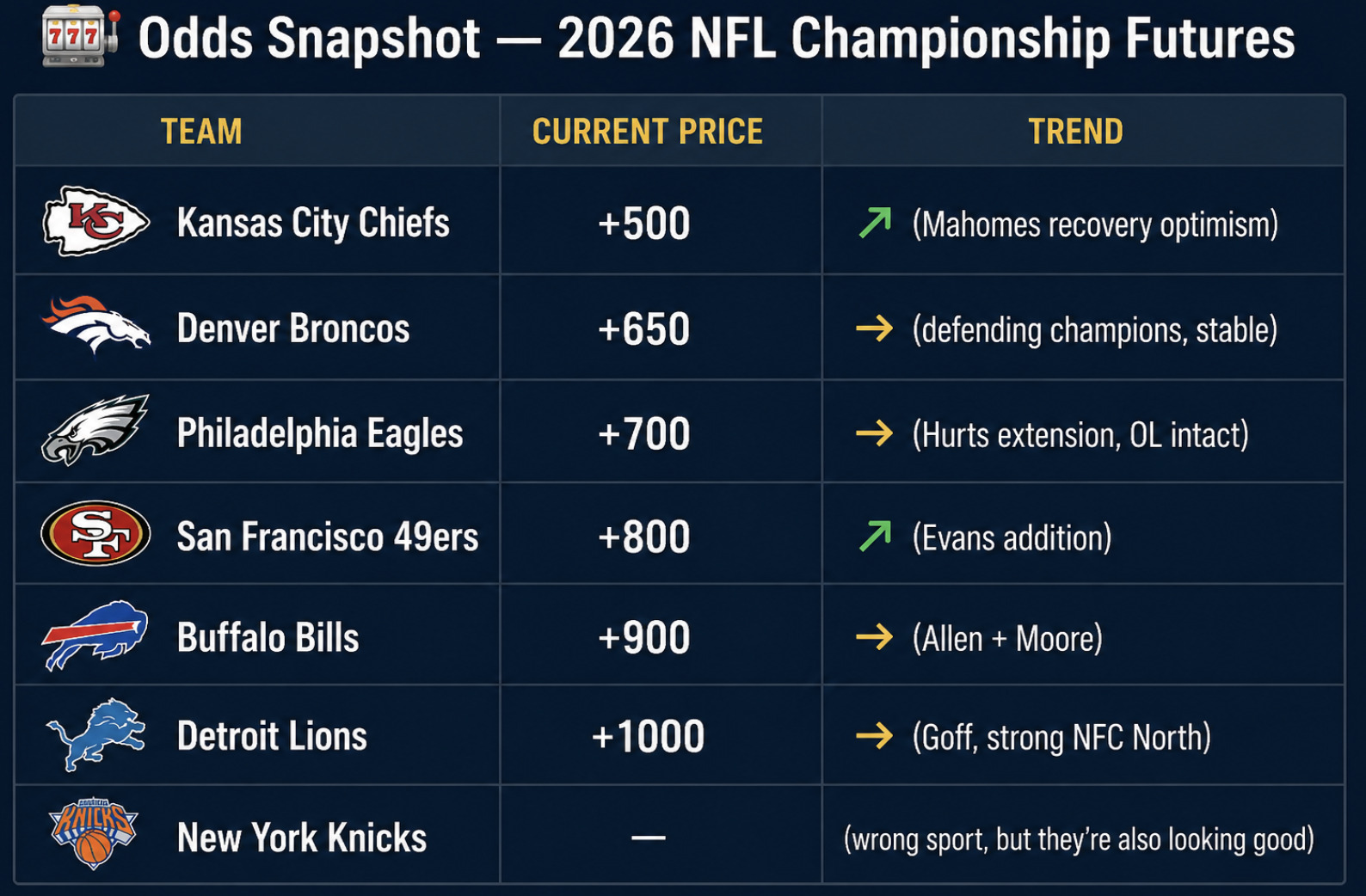
With the offseason settled and the schedule released, here is the realistic championship picture heading into 2026 training camps.
Kansas City Chiefs (+500 → real price if Mahomes is 100% healthy)
The Chiefs at plus-five hundred reflect exactly the uncertainty around Mahomes' recovery. A fully healthy Mahomes with a rebuilt roster — Fields as insurance, Walker and Etienne at running back, a schedule that starts at Denver in primetime — is still the best quarterback in football operating in the best organisation in football. The price will shorten significantly if the Week 1 performance is vintage. Bet the trend.
Denver Broncos (+650)
The defending champions. Nix has now had a full year as a starting quarterback with playoff experience, including a Super Bowl win. Waddle gives him something he did not have last year — a true separator in the route tree. Andy Reid is not at Denver; this is a different coaching staff. But the roster is built to win now.
Philadelphia Eagles (+700)
Jalen Hurts and an offensive system that does not require him to carry games, plus the best offensive line in football. The NFC championship runs through Philadelphia until someone proves otherwise.
San Francisco 49ers (+800)
Shanahan, Purdy, Evans, Samuel, Aiyuk. Top-five offense. The NFC West is legitimately strong in 2026 and the 49ers should win it.
Buffalo Bills (+900)
Josh Allen with DJ Moore, Stefon Diggs presumably retained or replaced, a defense that was top-ten last season. The Bills are the most consistent AFC contender not named Chiefs. Their ceiling is the AFC Championship Game.
The 2026 NFL season is the most interesting it has been in years because the dominant dynasty of the decade missed the playoffs for the first time — and its dominant player is coming back from the most serious injury of his career into a division where a new champion was just crowned. The league has needed a genuine power vacuum in the AFC to create storylines worth following. Patrick Mahomes's torn ACL provided it.
Whether he returns to fill that vacuum — or whether 2026 becomes the year the league's competitive landscape permanently changes — is the question that training camp, Week 1, and the first eight games of the season will begin to answer.
Training camps open in late July. September 14 cannot come fast enough.