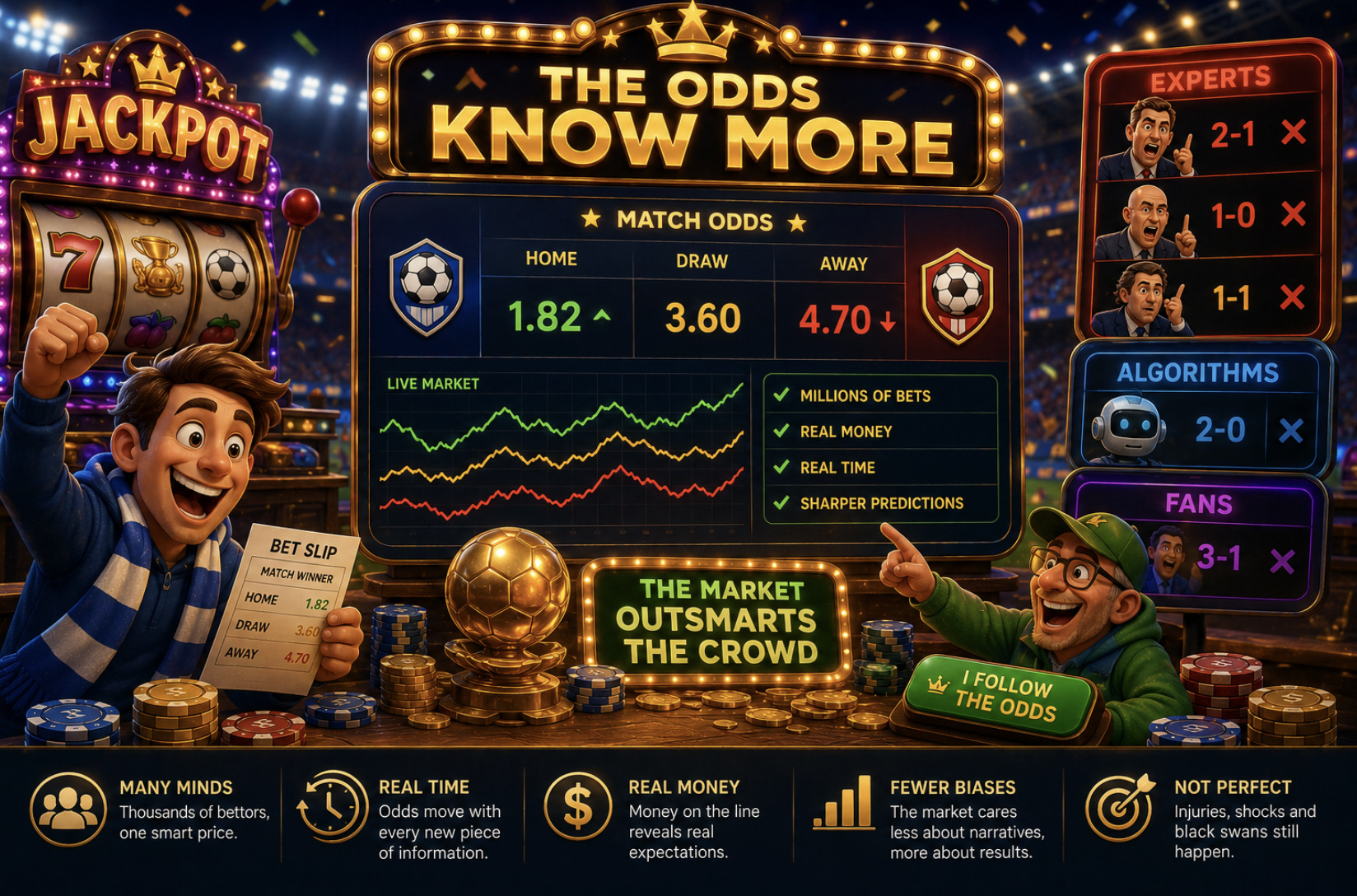
Before a big match, the noise is deafening. Pundits make confident calls, columnists back their hunches, and every fan has a theory. Yet if you want the single most reliable forecast of what is likely to happen, you rarely find it in any of those opinions. You find it in the odds. The betting market — the constantly shifting prices set and adjusted as money flows in — tends to out-predict the experts, the algorithms and the crowd of individual pundits, and it does so for reasons that have nothing to do with any one clever forecaster. Understanding why the market is so sharp, and where it still stumbles, is one of the most useful things a serious sports fan can learn about how prediction actually works.
The wisdom of a paying crowd
The market's power comes from aggregation. A single pundit, however knowledgeable, is one brain with one set of biases, blind spots and gaps in knowledge. The betting market is something else entirely: the combined judgement of an enormous number of participants, each bringing their own information, analysis and opinion, all expressed through the prices they are willing to bet at. When you aggregate that many independent estimates, the individual errors tend to cancel out while the genuine signal accumulates, and what emerges is often more accurate than almost any single expert within the crowd.
This is a version of a well-known phenomenon: under the right conditions, a large group's combined estimate can beat that of its smartest individual member. Markets are a particularly potent form of it, because they don't just collect opinions — they weight them by conviction and, crucially, by money. A participant who is confident and well-informed backs their view with a larger stake; one who is unsure stays out or bets small. The price that results is not a simple average of opinions but a money-weighted consensus, and money has a way of concentrating the minds of the people expressing it. That is why the market's forecast, distilled into a single number, so often outperforms the confident individual voices shouting around it.
Skin in the game changes everything
The deeper reason the market is sharp is the one the pundit lacks: consequences. A commentator who makes a bad prediction suffers nothing worse than a moment's embarrassment, quickly forgotten. A bettor who makes a bad prediction loses money. That difference is enormous, because it changes the quality of thinking that goes into the estimate. When being wrong is costly, people reason more carefully, discount their pet theories, and update quickly in the face of new information, because self-flattery is expensive and clarity pays.
This is what separates a market forecast from a mere opinion. Opinions are cheap; positions are not. The prices you see at a sportsbook or an online brand such as Wintino are the visible result of countless people putting money behind their judgement, and that financial stake acts as a relentless filter on wishful thinking. The market has no loyalty, no ego to protect, no narrative to sell — only the cold incentive to be right, because being wrong has a price. A pundit can afford to be interesting; the market can only afford to be accurate. Over time, that incentive gap is why the number tends to beat the noise.
Reading the market's forecast
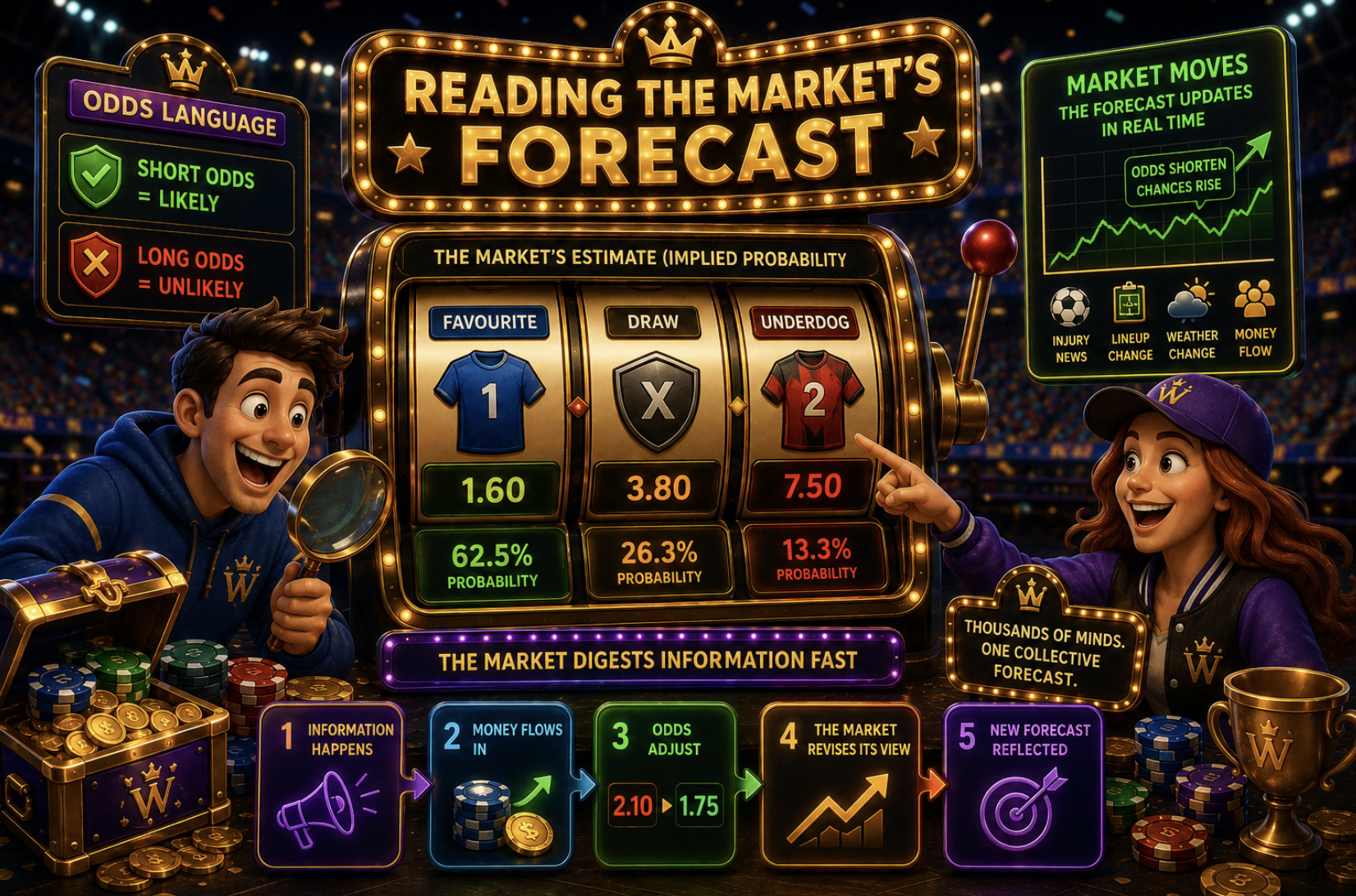
If the market is such a good predictor, it helps to know how to read what it is actually saying, because the odds are a forecast written in a particular language. Any price can be translated into the probability it implies — the market's own estimate of how likely an outcome is. Short odds mean the market thinks something is likely; long odds mean it thinks the opposite. When the price on a favourite shortens in the hours before a match, the market is telling you its collective estimate of that team's chances has risen, usually because new information or the weight of money has shifted the consensus.
Watching the market move is therefore like watching a forecast update itself in real time. A line that drifts one way is the aggregated judgement of thousands of participants revising their view, and it often reflects genuine information — an injury, a lineup, a change in conditions — faster and more accurately than any single analyst would. This is why sharp observers pay attention not just to where the odds are but to where they are moving: the movement is the market thinking out loud, revising its prediction as reality changes. Learning to read that is learning to read the most efficient forecasting mechanism in sport.
Where the market still gets it wrong
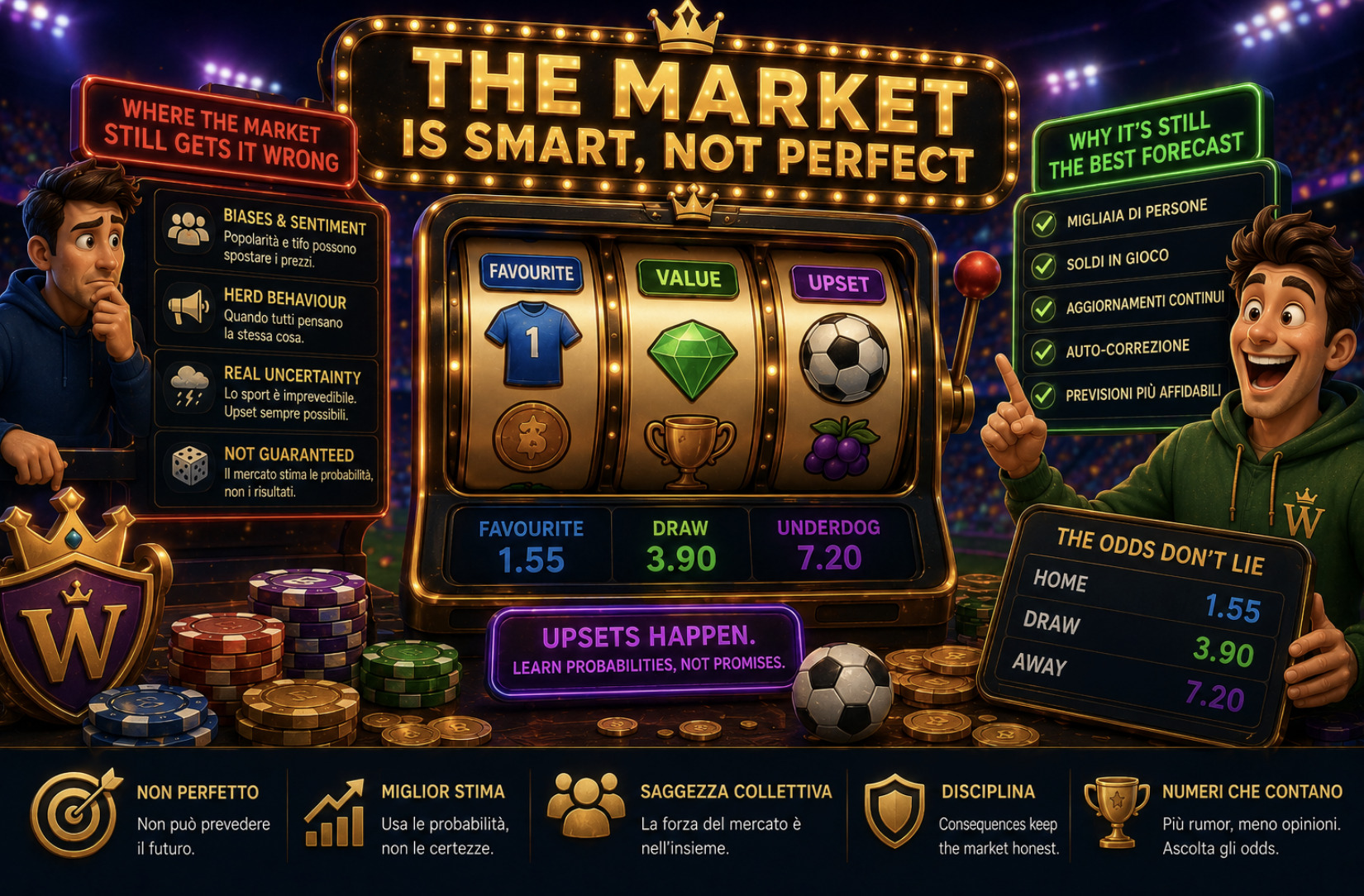
None of this makes the market infallible, and pretending otherwise is its own kind of error. The market is a very good predictor, not a perfect one, and it has known weaknesses worth understanding. Because it aggregates human judgement, it also aggregates human bias, and in some situations those biases don't cancel out but reinforce. Popular teams and heavily supported outcomes can attract money for reasons of sentiment rather than analysis, nudging prices slightly away from the true probability. The market is shaped by the people in it, and where those people share a bias, the market can inherit it.
There is also the simple fact that sport is genuinely uncertain, and no forecast — however sophisticated — can predict a specific result. The market gives you the best available estimate of probabilities, not a guarantee of outcomes, and even a well-priced favourite loses often enough to remind everyone that "most likely" is not "certain." The market is excellent at the long-run distribution of chances and silent on the single event, which is exactly why upsets happen without the market having been "wrong." Respecting both truths at once — that the market is remarkably sharp and that it cannot see the future — is the mark of someone who actually understands it.
The forecast worth listening to
The practical takeaway is not that you should bet, and certainly not that the market hands anyone a way to profit — the built-in margin and genuine uncertainty see to that. It is that the odds are the most honest and best-informed forecast available in sport, and reading them tells you more about what is likely to happen than almost any confident voice in the media. When a pundit's bold call clashes with the market's price, the market is usually the one to trust, not because it is smarter than everyone but because it is the aggregated, money-weighted judgement of everyone, filtered by the discipline of consequences.
So the next time the experts are loudly disagreeing before a match, glance at the odds and read them as what they are: the crowd's best collective guess, sharpened by skin in the game. You will not learn what will happen, because nothing can tell you that. But you will learn what is genuinely likely, expressed by the one forecaster in the room that cannot afford to fool itself. In a world full of confident opinions, that quiet, self-correcting number is usually the one worth listening to.