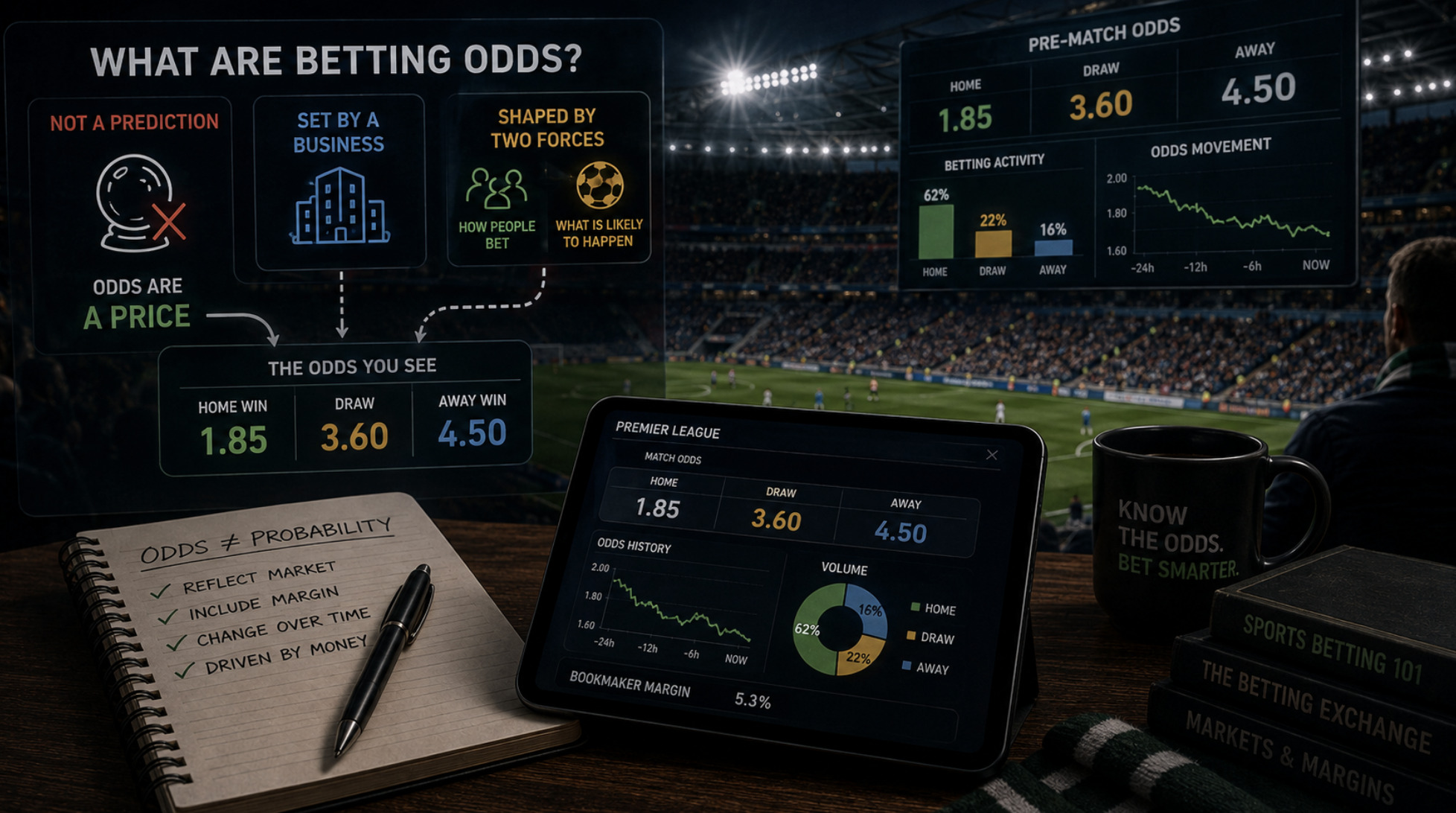
Ask most sports fans what betting odds are, and you will get some version of "the chance of something happening." It is a reasonable guess, and it is wrong in a way that matters. Odds are not a forecast handed down by an oracle; they are a price, set by a business, shaped as much by how people bet as by what is likely to happen on the pitch. Understanding what odds actually represent — and how they come to be the numbers you see — changes how you read every line, and it is one of the most useful things a fan can learn about the machinery behind modern sport.
Odds are a price, not a prophecy
Start with the single most important idea: odds are a price. A bookmaker is not trying to predict the future for its own sake; it is trying to set a number at which it can take bets on both sides of an outcome and come out ahead over time, regardless of who wins. That reframing explains almost everything else. When you see a team priced at 2.00 to win, the bookmaker is not saying "this team will win half the time" as a neutral scientific claim. It is offering you a transaction at a price it believes protects its margin given how the betting public is likely to behave.
This is why odds can differ from what a purely statistical model would say. A model estimates probability; a price incorporates probability and the business of taking bets. The two are related — a good price starts from a genuine estimate of the likelihood — but they are not the same thing, and conflating them is the root of most misunderstandings about betting. The number on the screen is where probability meets commerce, and the commerce never leaves.
From probability to a starting line
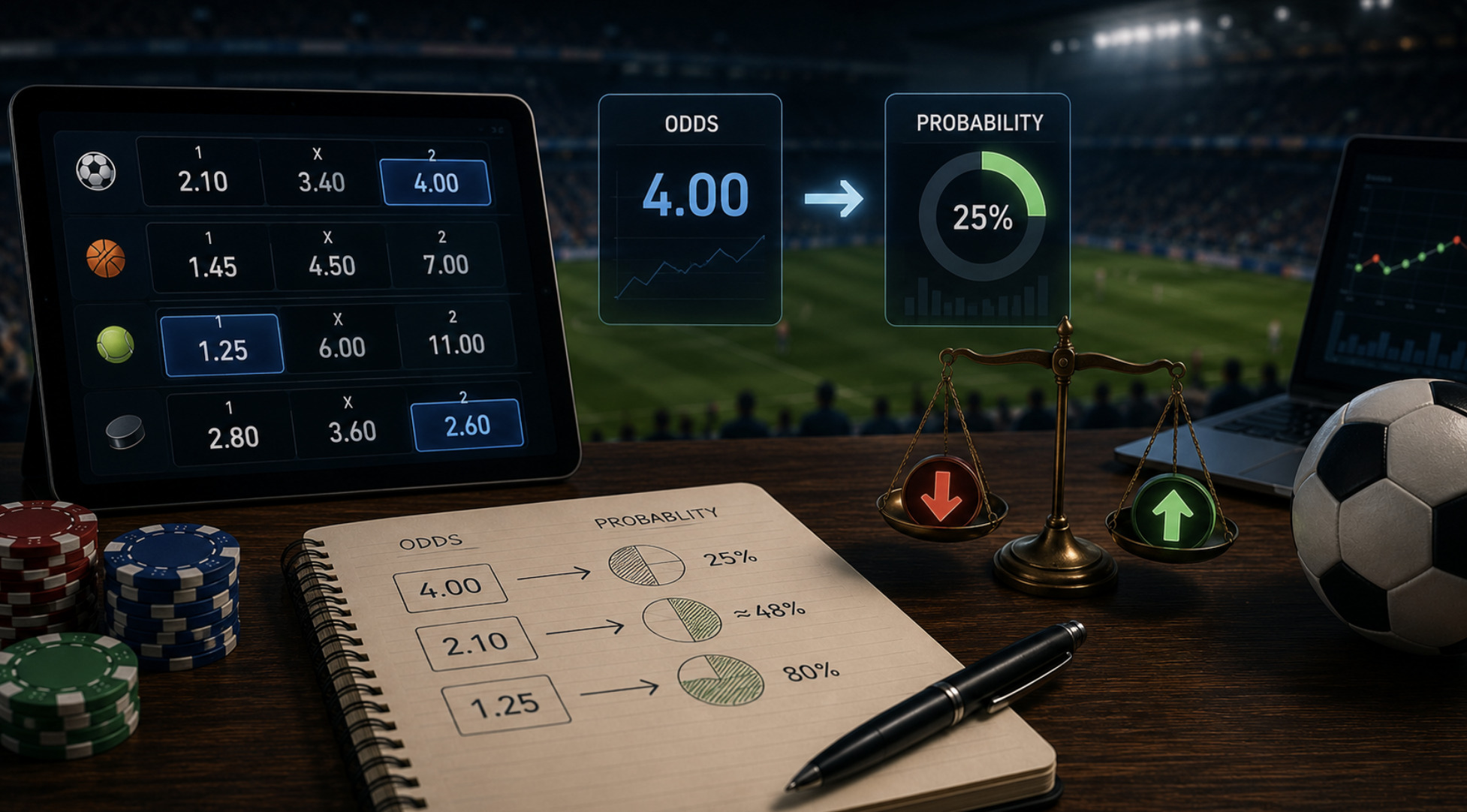
So how does a number actually get set? It begins with an estimate of probability. Odds-compilers — increasingly assisted by statistical models that chew through form, injuries, historical results, and countless other inputs — arrive at an estimate of how likely each outcome is. If they judge a team roughly 50% likely to win, that maps to a "fair" price of about 2.00; a 25% chance maps to about 4.00; an 80% chance to about 1.25. This conversion between probability and odds is simple arithmetic, and it runs in both directions, which is what lets you read a price back into an implied probability.
That last point is worth dwelling on, because it is the single most practical skill in reading odds. Any price can be turned into the probability it implies: divide one by the decimal odds, and you get the chance the price corresponds to. A price of 4.00 implies a 25% chance; 1.25 implies 80%. Learning to glance at a line and immediately think "that's about a one-in-three chance" is how you start to judge whether a price looks generous or mean — and it is the foundation for everything from spotting value to simply understanding what the market thinks. It also connects directly to how modern betting products present information, a shift we explored in why betting platforms are becoming UX products.
The margin: why the odds never quite add up
Here is where the "price, not prophecy" idea becomes concrete. If you convert every outcome in a market into its implied probability and add them together, they will total more than 100%. In a two-way market that should sum to 100%, you might find the implied probabilities add up to 105% or more. That extra slice is not a mistake; it is the bookmaker's built-in margin, sometimes called the overround or the vig. It is how the business makes money over time, and it is present in every market you will ever bet into.
Understanding the margin demystifies a lot. It explains why the odds on both sides of an even contest are a little shorter than the "fair" 2.00 you would expect from a true coin-flip — say 1.90 each side, which implies more than 50% for both. It explains why some markets (with many outcomes, like a first goalscorer) carry a larger margin than others. And it is the clearest possible illustration that odds are a commercial product: the house is not offering you a fair reflection of probability, it is offering you probability plus a cut. None of this is sinister — it is simply how the business works — but a fan who does not know the margin exists is reading the numbers wrong.
Why the lines move
Odds are not fixed once they are published; they move, sometimes dramatically, and understanding why is the final piece. The two forces that shift a line are new information and the flow of money. New information is intuitive: a star player is ruled out, the weather turns, a lineup is announced, and the estimated probabilities change, so the price changes with them. This is the part that matches the naive "odds reflect likelihood" view, and when it happens, it is exactly that.
The flow of money is the less obvious force, and it is where the "price" nature of odds shows most clearly. If a great deal of money piles onto one side of a market, a bookmaker will often shorten that side and lengthen the other — not necessarily because the true probability changed, but to rebalance its exposure and protect its margin as the betting comes in. This means a line can move purely because of how people are betting, independent of anything happening in the real world. Reading a moving line therefore means asking which force is driving it: fresh information, or the weight of money. That distinction is central to sharp analysis, and it underpins the way team styles and public perception feed betting markets, a theme we examined in why team playstyle shapes betting markets more than results.
Reading odds like someone who understands them
Put it all together and a picture emerges of what odds really are: a bookmaker's estimate of probability, converted into a price, inflated by a margin, and continuously adjusted for new information and the flow of money. Every number you see carries all four of those layers at once. The fan who understands this reads a line completely differently from the one who thinks the odds are simply "the chance of winning." They can extract the implied probability, mentally strip out the margin, and ask whether a moving line reflects real news or just betting patterns.
This understanding is valuable regardless of whether you ever place a bet, because it reveals how a huge part of the modern sports economy actually thinks about uncertainty. But it comes with an essential caveat that no honest explanation should omit: understanding odds does not let you beat them. The margin is always there, outcomes remain genuinely uncertain, and betting is a form of entertainment that costs money on average, not a way to make it. The point of learning how odds work is not to find a system — there is no reliable system — but to read the language of the market fluently, and to make any decision to bet a fully informed one, within limits you set in advance. If betting ever stops being fun, that is the moment to step back and seek support.
Frequently asked questions
What do betting odds actually represent? They represent a price, not a pure prediction. Odds start from an estimate of an outcome's probability, but they are then set as the price at which a bookmaker will take bets, including a built-in margin. So odds reflect probability and the commercial business of taking bets.
How do I convert odds into a probability? For decimal odds, divide one by the odds. A price of 4.00 implies a 25% chance (1 ÷ 4 = 0.25); a price of 1.25 implies 80% (1 ÷ 1.25 = 0.80). Doing this quickly lets you see what chance the market is assigning to an outcome.
Why do the implied probabilities add up to more than 100%? Because of the bookmaker's margin, sometimes called the overround. The extra percentage above 100% is how the business makes money over time. It means the published odds are always slightly shorter than the "fair" price a true probability would give.
Why do betting odds change before an event? For two reasons: new information (injuries, lineups, weather) that changes the estimated probability, and the flow of money, which can push a bookmaker to shorten one side and lengthen another to balance its exposure — even if the real probability has not changed.