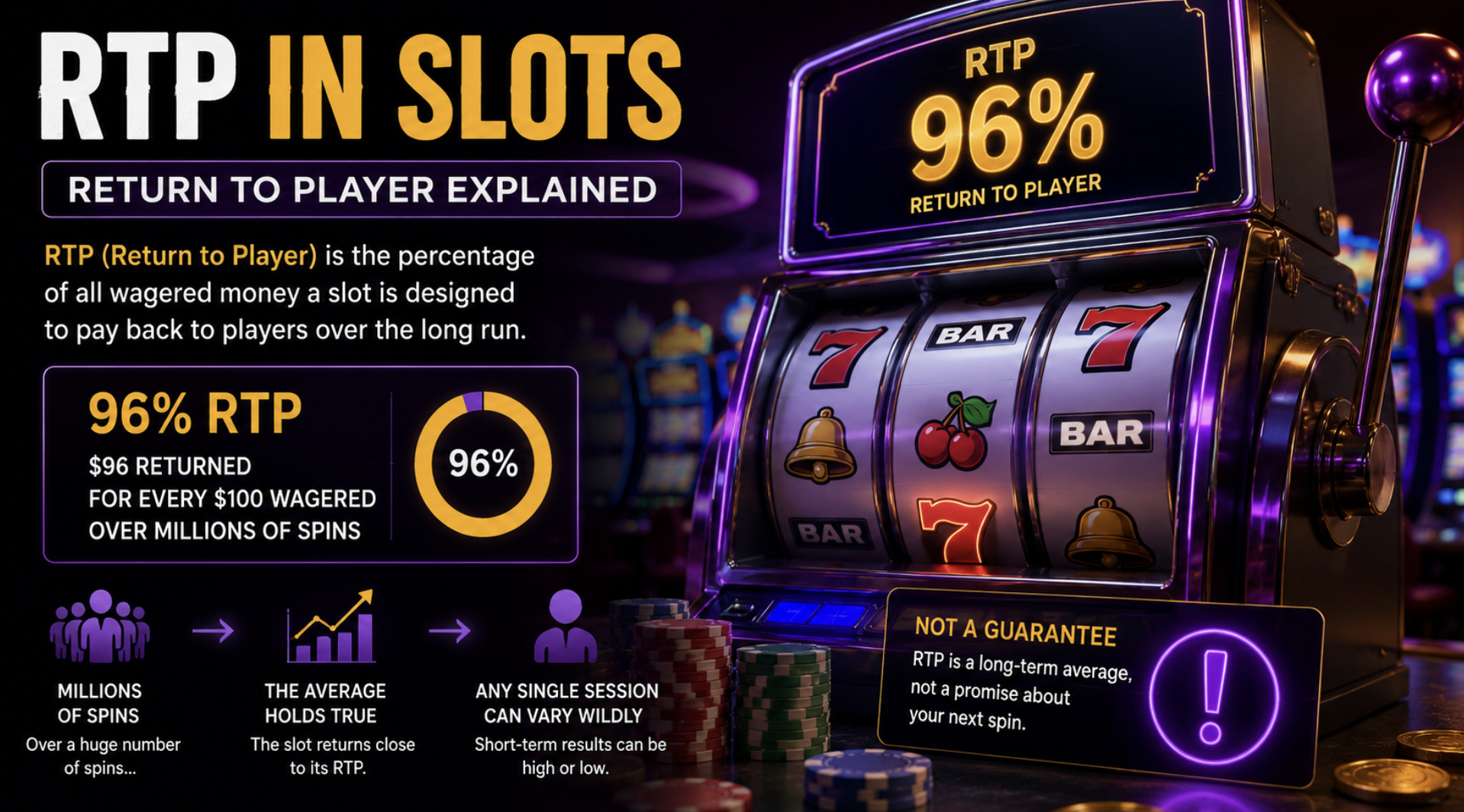
RTP in slots stands for Return to Player: the percentage of all wagered money a slot is designed to pay back to players over the long run. A slot with a 96% RTP is built to return, on average, $96 for every $100 wagered across millions of spins. It is a long-term mathematical average, not a promise about your next session — and understanding that distinction is the single most useful thing a slots player can learn.
What RTP actually measures
RTP describes the game, not your afternoon. It is calculated over an enormous number of spins, so while the figure is precise in the long run, any individual session can land anywhere. One player might turn $100 into $400; another might lose it all on the same 96% slot within minutes. Both outcomes are perfectly consistent with the stated RTP, because the percentage only reveals itself across a sample far larger than any person will ever play.
The complement of RTP is the house edge. If a slot returns 96% to players over time, the remaining 4% is the operator's long-run margin. RTP and house edge always add up to 100%, so a 96% RTP is the same statement as a 4% house edge, just viewed from the player's side rather than the casino's.
How RTP is calculated and tested
RTP is not a marketing number an operator invents. It is built into a game's mathematical model by its studio and then verified by independent testing laboratories that simulate millions or billions of rounds to confirm the game pays out as claimed. Independent testing agencies such as eCOGRA, GLI and iTech Labs specialise in this work, which is why a published RTP on a reputable game can be trusted as a genuine long-run figure rather than a guess.
For Canadian players, this verification sits alongside provincial oversight. In regulated markets such as Ontario, licensed operators work within a framework set by bodies like the AGCO and iGaming Ontario, which reinforces the expectation that published game information is accurate.
What counts as a good RTP
Most modern online slots sit between roughly 94% and 97%, with 96% a common benchmark. As a rough guide:
98%+ — excellent, but relatively rare.
96%–97.9% — good; the standard band for many popular slots.
94%–95.9% — average to below-average; your bankroll tends to erode faster.
Below 94% — worth a second look before you play.
A higher RTP means the game is designed to return more over time, which generally helps a bankroll last longer. It does not, however, mean you are more likely to win on any given spin — a crucial distinction the next section untangles.
RTP vs volatility — the pair people confuse
RTP tells you how much a slot returns over time; volatility tells you how bumpy the ride is. Two slots can share a 96% RTP yet feel completely different: a low-volatility game pays small amounts frequently, while a high-volatility game pays rarely but larger. RTP is the destination; volatility is the road. Reading a game's information panel for both figures gives a far fuller picture than RTP alone. Many Canadian platforms now display a game's RTP and volatility directly in the info screen — on sites such as Casoola and other regulated operators, that information sits a tap away before you spin — which makes it easy to check both numbers rather than guessing.

Common RTP myths that cost players
"A 96% RTP means I'll get $96 back from my $100." No. That average only emerges over millions of spins, not one session. "A slot is 'due' after a losing streak." No. Each spin is independent, decided by a random number generator, with no memory of what came before. "Higher RTP guarantees I'll win." No — it improves long-run return but changes nothing about the randomness of a single result. Treating RTP as a session guarantee is the most expensive misunderstanding in slots.
How Canadian players can use RTP well
Use RTP as one input, not a strategy. Check the figure in the game's info panel before playing, pair it with the volatility rating to match your risk appetite and bankroll, and set a budget you are comfortable losing regardless of the number. A high RTP can help your money last longer, but no RTP makes a game profitable to play — the edge always favours the house over time, which is exactly why setting limits matters more than chasing percentages.
Frequently asked questions
Is a 96% RTP good? Yes, 96% is a solid, standard figure for online slots. Games above 97% are better for long-run return, but 96% is comfortably within the "good" range.
Does RTP mean I will win back that percentage? No. RTP is a long-term average across millions of spins. Your individual session can land anywhere, well above or below the figure.
What is the difference between RTP and house edge? They are the same information from opposite sides. RTP is what the game returns to players over time; the house edge is the remainder the casino keeps. They add up to 100%.
Where do I find a slot's RTP? Usually in the game's information or help panel, and often in the game's rules. Many regulated Canadian platforms display it directly before you play.