
The quickest way to get better at Football Bros is to stop treating it as a button-mashing game. The controls are deliberately minimal: you move, and you press one action key. Most improvement therefore comes from when you press that key, where your player is standing and which option you choose, not from discovering hidden inputs.
This guide covers the controls you need, how to use timing and positioning on offence and defence, the mistakes that cost beginners the most, and a simple way to practise one skill at a time.
What is confirmed about the controls
It helps to separate what the game documents from what players work out through practice.
On the official browser version’s game page, the documented keyboard controls are short:
Movement: arrow keys or WASD.
Action: Space. The page describes it as the key used to pass, tackle or perform special moves. Its FAQ is more specific: Space passes on offence and tackles on defence.
Defensive control: the game switches between your players automatically on defence.
The documented modes are a single-player game against the CPU and a two-player game on the same keyboard. The objective is simple: score more touchdowns than your opponent before the clock runs out.
That’s essentially everything officially stated. The page doesn’t publish a list of named special moves, and it doesn’t explain exactly how the game picks a pass target or which defender you’ll be switched to. Anything beyond the controls above is something you learn by observing the game, and the advice in the rest of this guide is labelled with that in mind. It is strategy, not hidden mechanics.
If you play on a phone or tablet, the controls shown on screen may differ from the keyboard layout. Check what your version displays before relying on keyboard habits.
One key, two jobs
Because Space handles passing on offence and tackling on defence, the same key press means something different depending on who has the ball. This is what context-sensitive means in practice: the game decides what the action does based on the situation, not on a separate button.
That has two consequences beginners often miss.
First, a habit formed on one side of the ball can hurt you on the other. If you press Space reflexively the moment play starts on offence, you may release the ball before your receivers have run anywhere useful. If you press it too early on defence, you commit to a tackle before the ball carrier is within reach.
Second, because there’s only one action, the timing of that action is the main skill the game tests. Two players using identical controls can get completely different results simply because one of them presses Space half a second later.
Why timing beats repeated pressing
Pressing the action key repeatedly feels proactive, but it hands control to luck. A few illustrative situations show why waiting a moment usually produces better decisions.
On offence
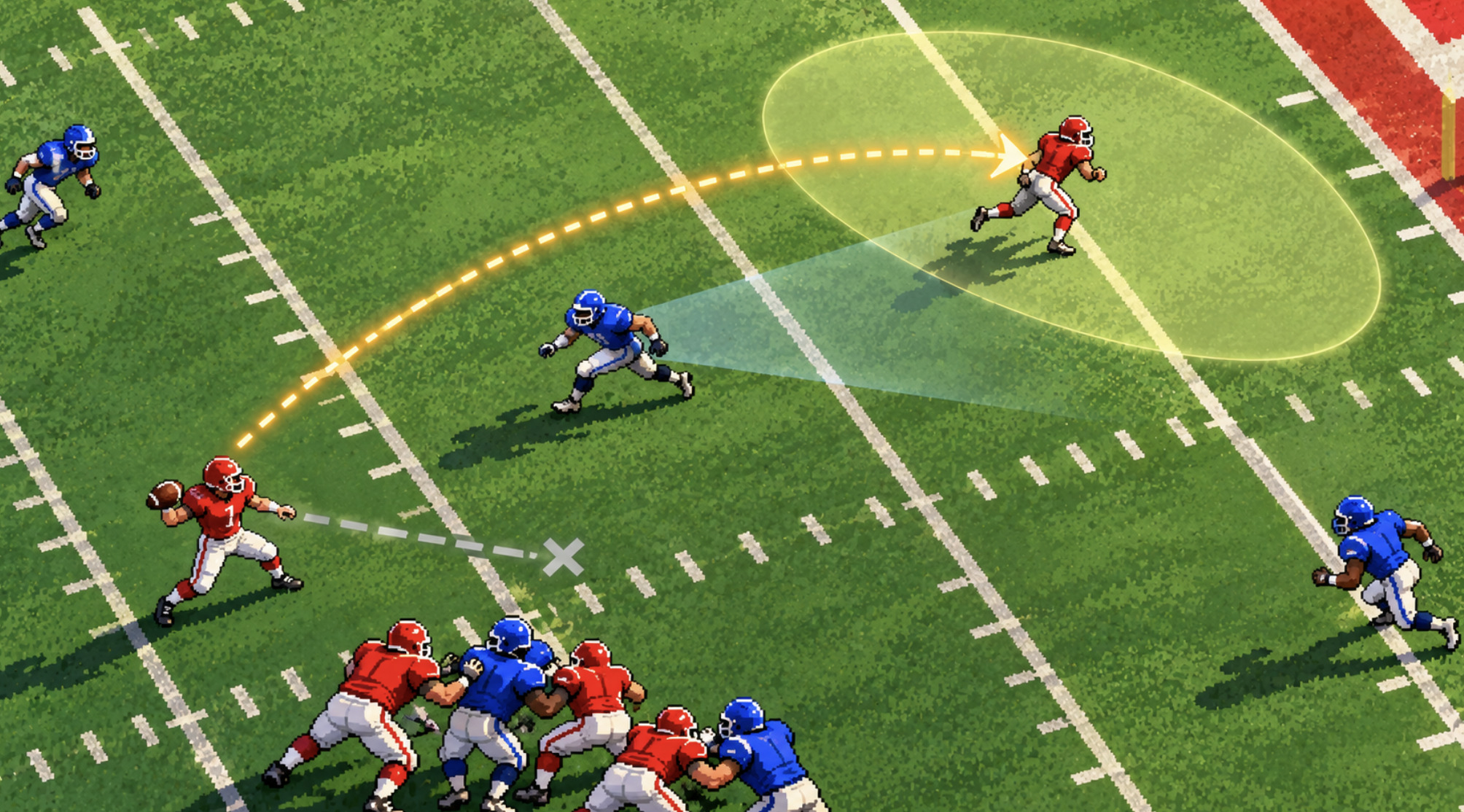
When a play starts, your receivers need time to separate from defenders. If you pass immediately, you’re often throwing into the space where defenders already are. Holding the ball for a brief moment while you watch how the defence moves lets you see whether a lane is opening.
The trade-off is pressure. Waiting too long gives defenders time to close in on the ball carrier. The skill is finding the window between “too early to be open” and “too late to escape the rush”.
On defence
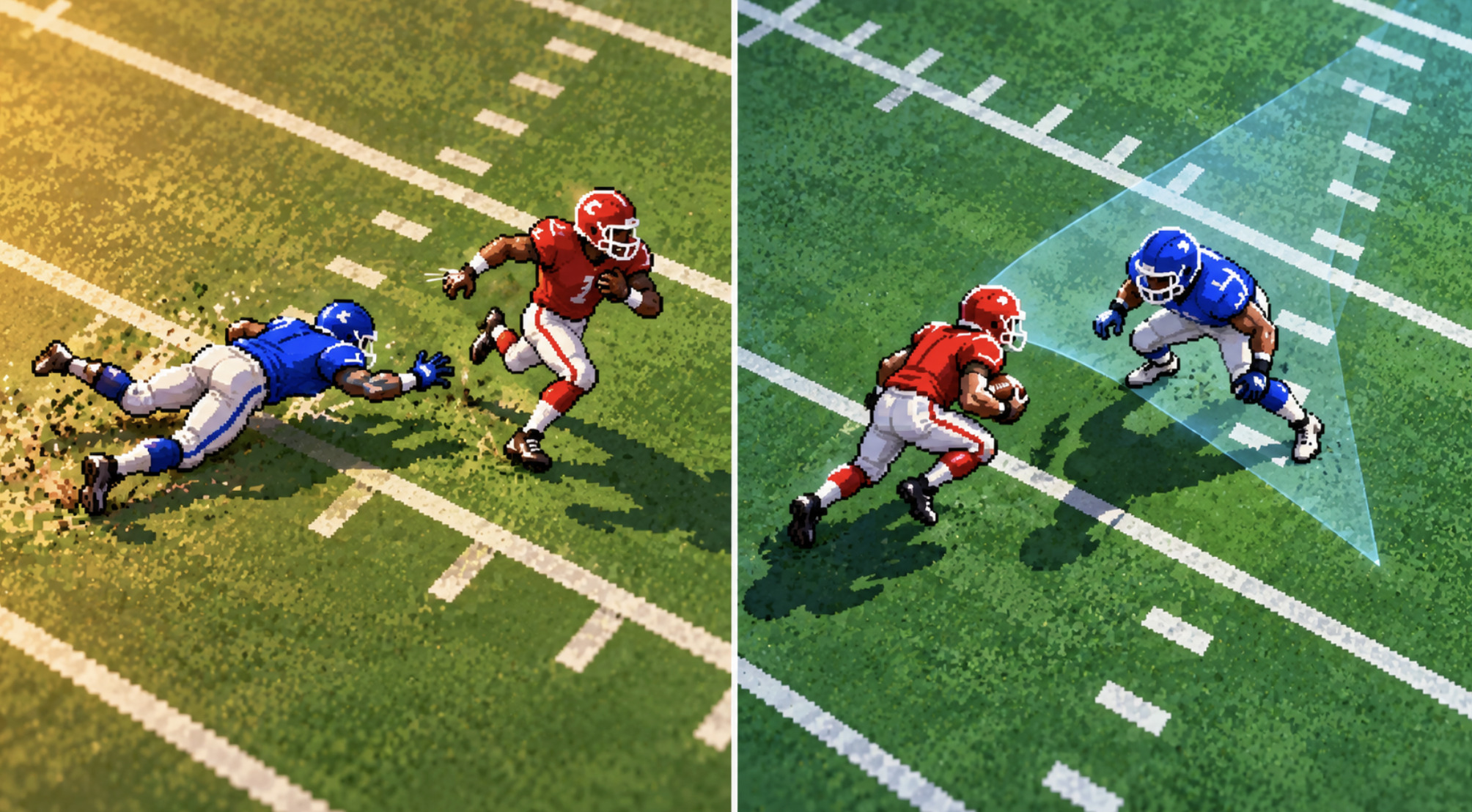
A tackle attempt that misses usually leaves your player out of position, at least for a moment. A ball carrier who sees you commit early can change direction around you into the space you just left. That is why a mistimed tackle often creates a bigger opening than not attempting one at all.
A more patient approach is to close the distance first and press Space only when the ball carrier is close enough that their escape options are limited.
How to find passing opportunities
The game doesn’t document exactly how it chooses who receives a pass, so the practical approach is to observe your own version and form habits around what you see. Try a few short sessions and pay attention to which receiver tends to get the ball depending on where your player is facing, where the receivers are and when you press the key.
Whatever the exact targeting behaviour, the strategic principles below apply in most American football games, and they translate well here.
Pass rather than run when
A defender has committed to the ball carrier. If a defender is moving straight at you, someone downfield is likely to have less coverage.
Your running lane is closing. If several defenders are converging on the path ahead, a pass can move the ball past them more quickly than running can.
A receiver is moving away from their defender. Separation tends to be greatest just after a receiver changes direction or when the defender has turned towards the ball carrier.
Keep running rather than pass when
The field ahead of you is open. A long, clear run can gain more ground than a risky throw.
Every receiver is closely covered. Throwing into tight coverage gives the defence a chance to stop the play.
You’re close to the end zone with space to move. A short run may be the simplest route to a score.
An example decision
Imagine you receive the ball and run diagonally across the field. One defender angles towards you, while a receiver on the far side runs into open space behind him. Continuing to run means beating that defender one-on-one. Passing means taking advantage of the space he has left. In this case the pass is usually the stronger choice, because the defender’s commitment has already created the opening.
Nothing guarantees the pass will succeed, but the decision is based on what the defence did rather than on what you planned before the play started.
Avoiding predictable offence
The CPU and human opponents both punish repetition. If every play looks the same, defenders learn where to be. Small variations make you harder to read.
Vary the direction of your initial movement. Starting every play by running in the same direction makes it easier for defenders to anticipate your path.
Mix runs and passes. If you always pass early, defenders can drop back into coverage. If you always run, they can crowd forward.
Change your timing. Passing at slightly different moments from one play to the next makes it harder for opponents to anticipate the throw.
The idea is not to be random. It’s to make your decisions depend on what the defence shows you, instead of on a fixed routine.
Approaching defenders on offence
When you’re carrying the ball and a defender approaches, the worst choice is often to run straight at him. A straight line gives the defender an easy angle.
A better habit is to move into space before contact. Change direction early enough that the defender has to adjust, rather than at the last instant when you’re already within reach. Running towards the sideline can also reduce the number of directions you can be tackled from, though it limits your own options too.
If you find yourself stopped repeatedly in the same spot, look at the angle you took, not just the moment of the tackle. Most stops begin a second or two earlier, with a path that gave the defender a clear line.
Improving your defensive positioning
On defence the game switches your controlled player automatically, so your job is to make good use of whoever you’re controlling at that moment.
Stay between the ball carrier and the end zone
The most reliable defensive position is between the ball carrier and the end zone you’re protecting. From there, every option the ball carrier has requires him to get past you. Chasing directly behind a runner is far less effective, because you have to be faster to catch up.
Take angles, not straight lines
Instead of running at where the ball carrier is now, move towards where he will be if he keeps his current direction. Taking an angle closes distance faster and leaves him less room to change direction.
Watch receivers before the throw
If the opposing player tends to pass, your controlled defender can position himself in the space between the ball carrier and the most open receiver. Even if you don’t stop the pass, reducing the size of the open space makes the throw harder.
Don’t commit too early
As described above, a missed tackle can leave a gap. Close in first, then attempt the tackle when the ball carrier has fewer escape routes.
Common beginner mistakes
Pressing Space constantly. On offence it can release the ball too early. On defence it can commit your player before he’s in range.
Running only in straight lines. Straight paths are easy for defenders to read and intercept.
Ignoring receivers. New players often focus only on the ball carrier and miss open teammates downfield.
Chasing from behind on defence. Positioning ahead of the ball carrier is more effective than pursuing him.
Repeating the same play. Opponents learn patterns quickly, whether they’re people or the CPU.
Not reviewing failed plays. Every stopped run or missed tackle contains a lesson about angle, timing or choice.
How to practise one skill at a time
Trying to improve everything at once makes it hard to see what’s working. A more effective approach is to choose one focus per session.
Session 1: Passing timing
Play a few games where your only goal is to pass at a better moment. Before each throw, count a short beat and watch the defence. Notice which receivers tend to be open and how the defence reacts when you wait. Don’t worry about the score.
Session 2: Running angles
Focus on changing direction before contact. Each time you’re tackled, think back to the path you were taking just before. Over several games, you should start seeing which angles give defenders easy chances.
Session 3: Defensive patience
On defence, deliberately delay your tackle attempts until the ball carrier is close. Compare how often you stop him with how often he escapes after an early attempt.
Session 4: Reading opponents
Pay attention to what your opponent repeats. Do they always run one way first? Do they pass at the same moment each play? Once you notice a pattern, adjust your positioning to take that option away.
Playing against a friend in two-player mode is especially useful for this. Human opponents adapt in ways that help you test whether your new habits hold up.
Learning from a failed play
When a play goes wrong, ask three short questions:
What did I see? Was the defence moving towards me, or were my receivers covered?
What did I choose? Did I run, pass or attempt a tackle, and at what moment?
What else was available? Was there an open receiver, a lane on the other side of the field or a better defensive angle?
This turns a frustrating moment into information. Over time, you’ll notice that most mistakes come from a few repeated habits, and those are the easiest things to fix.
Getting started
If you haven’t played yet, the browser version hosted at bonus lists the core keyboard controls on its game page and runs without a download. Starting with a few games against the CPU is a sensible way to get used to the single action key before you challenge a friend on the same keyboard.
Football Bros rewards patience more than complexity. With only movement and one action to manage, your real tools are timing, positioning and decision-making. Concentrate on when you press the key and why, and your results should become more consistent, even though no single technique will win every game.