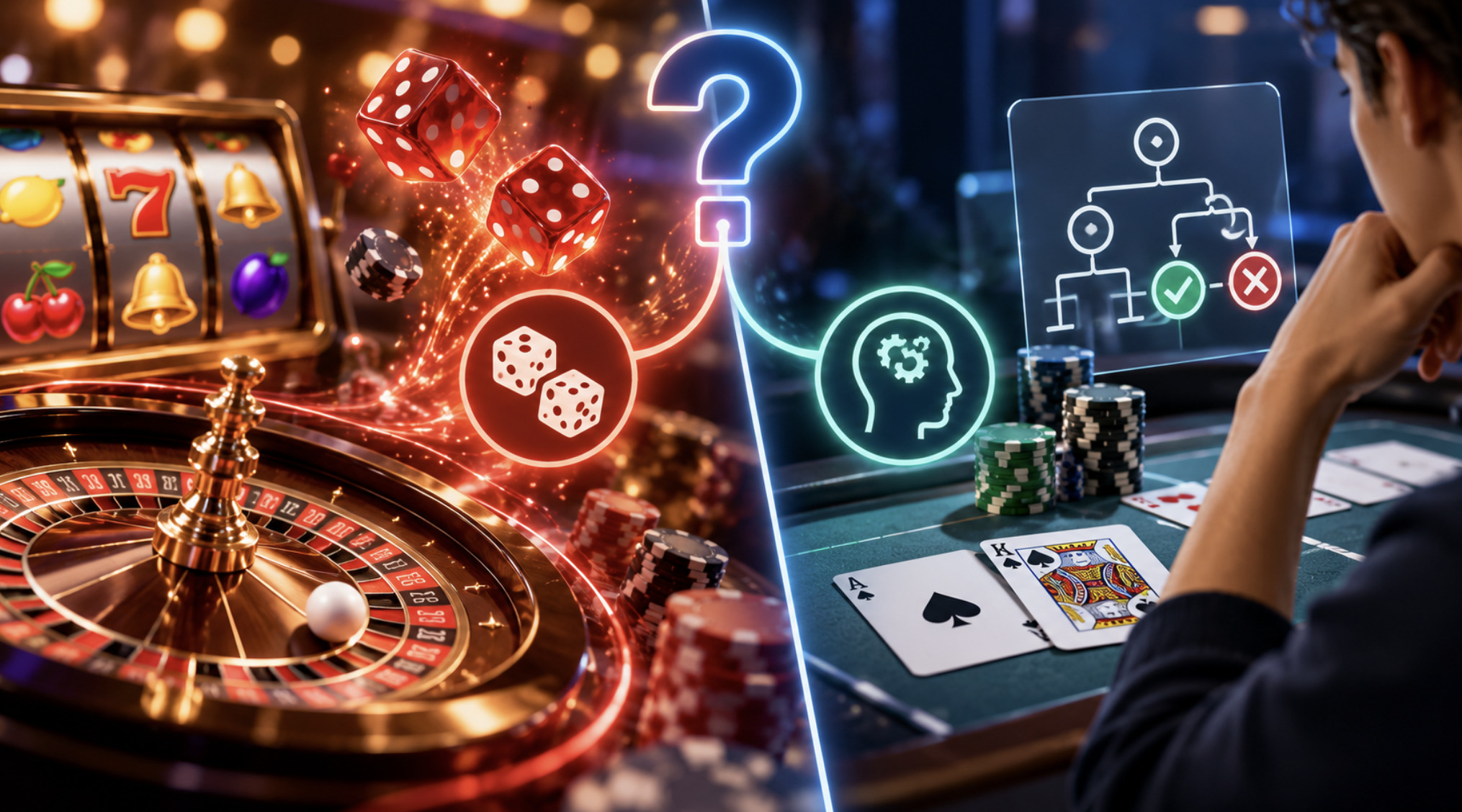
Most online casino games are based mainly on luck. In slots, roulette and most other casino games, the outcome of each round is decided by a random number generator, and nothing the player does changes the odds. A few games, such as blackjack, video poker and poker, involve real decisions, so knowledge and good play can change how much a player is likely to lose over time. Even then, skill improves your decisions. It doesn’t control the cards or the spin, and in games played against the house it doesn’t remove the built-in house edge.
That’s a very different picture from the games most readers of this site play, where practice genuinely changes results. Understanding why is the clearest way to see what “skill” and “luck” really mean.
Three kinds of games
It helps to think of games on a scale rather than as two boxes.
Games decided mainly by skill
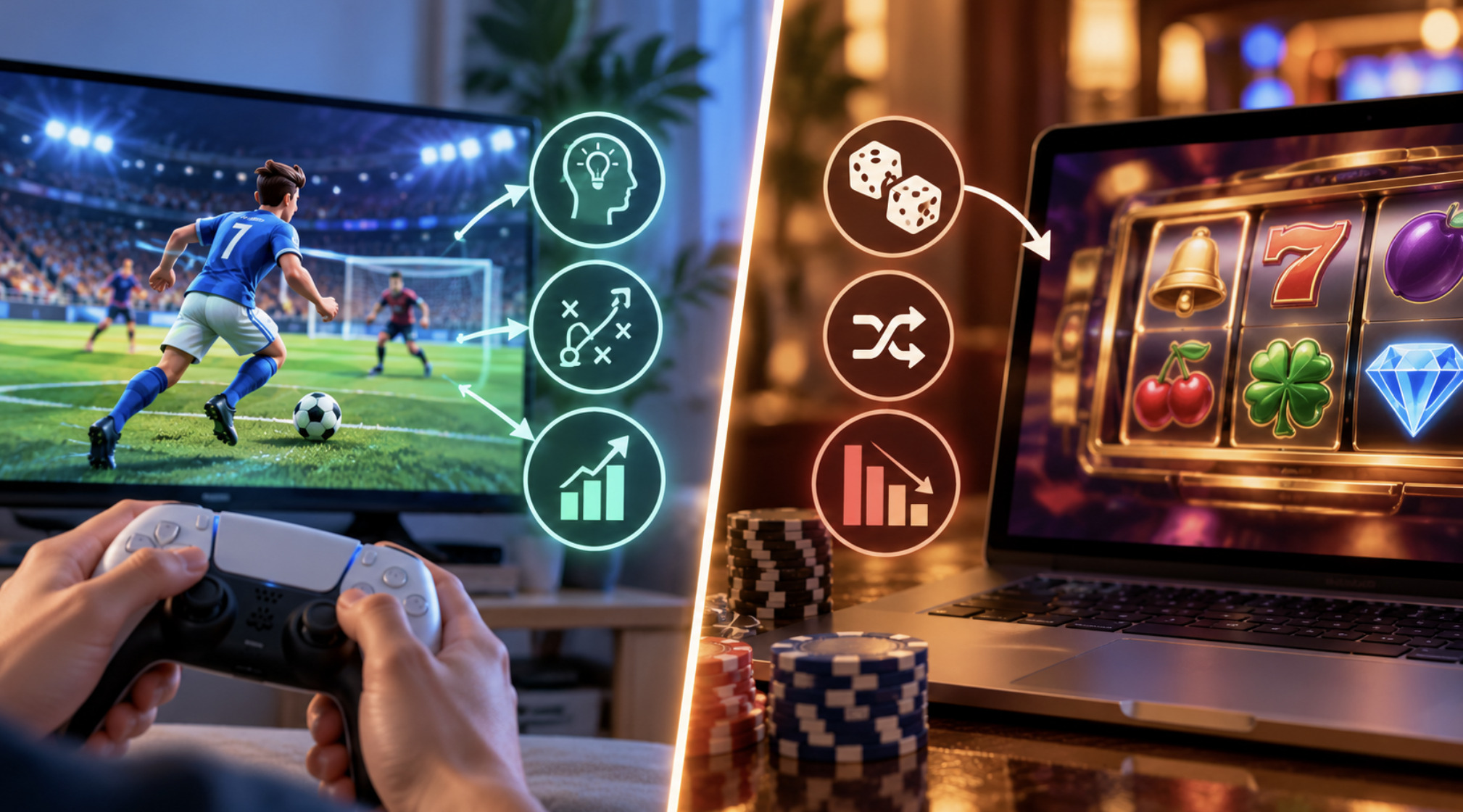
In competitive video games, sports and games like chess, the player’s actions determine the outcome. If you play Football Bros, the timing of a pass, the angle of a run and the decision to wait before tackling all affect what happens. Practise those decisions and your results improve. Two players with the same controls get different outcomes because one of them is better.
Skill-based games share some recognisable features:
results improve consistently with practice;
better players beat weaker players far more often than chance would suggest;
decisions made in real time, such as timing, positioning and reaction, change the result directly.
Games decided mainly by chance
In a slot machine or a roulette spin, the player makes a choice, such as how much to bet and on what, but once the bet is placed, the result is out of their hands. An experienced player and a first-timer face exactly the same odds on every spin. There’s no technique for pressing the spin button that changes the outcome.
Games combining decisions and chance
Some games sit in between. In blackjack, the cards are random, but the player decides whether to hit, stand, double or split, and those choices change the expected result. Poker adds another layer, because players compete against each other, not against the house, so making better decisions than opponents matters over time. Even so, a single hand can be lost to bad luck no matter how well it’s played.
Type of gameExampleWhat skill changesMainly skillCompetitive video games, chessThe outcome itselfMixedBlackjack, video poker, pokerThe quality of decisions and long-run expectationMainly chanceSlots, rouletteEssentially nothing about the odds
How online casino games create randomness
What a random number generator does
Online casino games use a random number generator (RNG), software that produces sequences of numbers with no predictable pattern. When you press spin or deal, the game uses one or more of these numbers to determine the result: which symbols land on a slot’s reels, where a digital roulette ball stops, or which cards are dealt.
Most digital RNGs are technically pseudorandom: they use mathematical algorithms that produce sequences which behave as random for practical purposes. Implementations differ between game developers and platforms, so there’s no single universal RNG design.
Why RNGs need testing
An RNG doesn’t make a game fair just by existing. What matters is whether it works correctly and whether the game’s rules and payouts are implemented as described. In regulated markets, game software is typically tested by independent testing laboratories before release, and regulators set technical standards that games must meet. A claim that a game “uses an RNG” says nothing on its own. Whether the game has been tested and licensed under a recognised regulator is what gives the claim meaning.
What “independent outcomes” means
Each spin of a slot or roulette wheel is independent of every other one. The RNG doesn’t remember previous results and doesn’t adjust future ones to balance things out. The chance of a particular result on the next spin is exactly the same whether the last spin won, lost or produced something that looked almost like a jackpot.
That’s why past results don’t predict future ones. Ten losing spins in a row don’t make a win more likely on the eleventh. Ten red numbers in a row at roulette don’t make black more likely next time.
Why random patterns look like skill
Human brains are built to find patterns, and random sequences produce plenty of patterns that mean nothing.
Streaks happen naturally. In any long random sequence, runs of wins or losses are normal. A player who wins three times in a row may feel they’ve found a method, when they have simply experienced an ordinary cluster in random results.
Choices create a sense of control. Picking numbers, choosing when to spin or changing the bet size can feel like strategy. Psychologists have long described an “illusion of control”, where people behave as though their choices influence outcomes that are actually determined by chance.
Memory is selective. Wins tend to be remembered more vividly than losses, so a “lucky” method can seem to work far better than it does.
There’s an interesting contrast with sport. In skill-based games, streaks can reflect something real. A player who is in form, confident and well prepared may genuinely perform better for a period, and researchers have found some evidence for a “hot hand” effect in basketball shooting. In an RNG-driven casino game, there is no form to be in. A streak is just a streak.
RTP and house edge explained
Return to player
Return to player (RTP) is the percentage of all money wagered on a game that it is designed to pay back to players over the long run. A slot with a 96% RTP is designed to return, on average, £96 for every £100 staked across an enormous number of plays.
House edge
House edge is the other side of the same calculation: the average share of each bet the game is designed to keep. A 96% RTP corresponds to a 4% house edge.
Some casino games make this easy to calculate. A European roulette wheel has 37 pockets, numbers 1 to 36 plus a single zero. A bet on a single number pays 35 to 1, but there are 36 other pockets where it loses. Working through the numbers shows that the house keeps, on average, 1/37 of each bet, about 2.7%. American roulette adds a double zero, giving 38 pockets and an edge of 2/38, about 5.26%, on most bets.
What RTP does not mean
RTP is not a personal payout promise. A 96% RTP doesn’t mean that a player who stakes £100 will get £96 back. It describes the average across a very large number of plays by all players.
Here is a hypothetical example. Suppose someone plays 1,000 spins at £1 each on a slot with a 96% RTP. They have staked £1,000 in total. The theoretical expected return is £960, an expected loss of £40. In practice, the actual result could be very different: a large loss, a small loss or, occasionally, a win. This is called variance. Games with high variance pay out less often but in larger amounts, so short-run results can swing widely in either direction.
Over a short session, luck dominates what happens. Over an extremely large number of bets, results tend to move towards the house edge. That’s the core of how casino games are designed to be profitable for the operator.
Where strategy actually matters
Blackjack
Blackjack is the clearest example of a casino game where decisions change the expected outcome. “Basic strategy” is the mathematically best decision for each combination of your hand and the dealer’s visible card, worked out from the probabilities of the remaining cards. Following it significantly reduces the house edge compared with playing by instinct. Under common rule sets it can bring the edge close to, but generally not below, zero. The exact figure depends on the rules: the number of decks, how blackjacks pay, and what the dealer does on a soft 17.
In online blackjack using an RNG, cards are typically shuffled for every hand, which removes the card-counting techniques sometimes associated with physical tables.
Video poker
Video poker also rewards correct decisions about which cards to keep. Each version has an optimal strategy, and the game’s published return assumes the player follows it. Mistakes reduce the actual return.
Poker
In poker, players compete against each other, and the house usually earns money by taking a fee or a share of each pot. Skill matters here in a way it doesn’t in other casino games, because better decisions over many hands can outperform weaker opponents. But luck strongly affects individual hands and short sessions, and the fee is taken regardless of who wins.
Slots and roulette
In slots and roulette, there’s no strategy that changes the odds. Choosing different bets in roulette changes how often you win and how much you win when you do, but nearly every bet carries the same house edge. Betting systems that increase stakes after losses, such as the Martingale, don’t change the expected result. They only change the pattern of wins and losses, and they can lead to large losses quickly.
Skill, knowledge and guarantees are different things
These distinctions are easy to blur.
Knowledge of the rules helps you understand what you’re betting on and avoid obvious mistakes.
Optimal play means making the best available decision in games that offer real choices, like blackjack.
Random outcomes remain random. Good decisions can’t control the next card or spin.
Guaranteed winnings don’t exist in games with a house edge. No strategy removes the mathematical advantage built into the game.

Game difficulty and house advantage are also separate ideas. A game can feel complicated without giving you any more control, and a simple game can have a smaller house edge than a complex one.
Separating game mechanics from marketing
Promotional material often blurs the line between luck and skill with phrases like “beat the odds”, “winning strategies” or “hot games”. When looking at any named operator, such as Westio Casino or any other site, it’s worth separating what the marketing says from how the games actually work. The useful questions are factual ones: is the game mainly decided by an RNG? Does it involve genuine decisions? What RTP is published for that specific game, and is it confirmed by the game’s official information? Is the operator licensed by a recognised regulator in your country? A site’s overall reputation tells you little about the odds of an individual game.
Why this matters
The skill you build in Football Bros is real. Better timing, positioning and decision-making genuinely change your results, and the game rewards practice. Most online casino games work the other way round: the outcome is set by an RNG, practice doesn’t change the odds, and the house edge is built into the mathematics. Even in the games where decisions matter, skill only reduces how much you’re likely to lose. It doesn’t turn the game into a reliable way to make money.
Knowing which kind of game you’re playing is the most useful piece of strategy there is. If gambling stops feeling like entertainment, support services and the limit-setting tools offered by licensed operators are there to help.